Friday, October 17, 2014

Asking ko-questions in spoken Finnish

Asking questions with the question ending ko or kö can be a bit different in spoken language. Some people don't really say the ko or kö, but instead, there's a ks between the verb and the personal pronoun.

  • Onko sinulla rahaa? > Onks sul rahaa? - Do you have money?


Examples with syödä, to eat.


First the written language version, then the same question in spoken language:

  • Syönkö minä? > Syönks mä? - Do I eat?
  • Syötkö sinä? > Syöks sä? / Syöt sä? - Do you eat? (Yes, two variations!)
  • Syökö hän? > Syöks se? - Does s/he eat?
  • Syömmekö me? > Syödäänks me? - Do we eat?
  • Syöttekö te? > Syötteks te? - Do you eat?
  • Syövätkö he? > Syöks ne? - Do they eat?

In a negative question, the ks ending is added to ei.


  • Enkö minä syö? > Enks mä syö? - Don't I eat?
  • Etkö sinä syö? > Eksä / Etsä syö? - Don't you eat?
  • Eikö hän syö? > Eiks se syö? - Doesn't s/he eat?
  • Emmekö me syö? > Eiks me syödä? - Don't we eat?
  • Ettekö te syö? > Etteks te syö? - Don't you eat?
  • Eivätkö he syö? > Eiks ne syö? - Don't they eat?

10 random eating-related questions in spoken language:


  1. Onks teillä mitään syötävää? - Do you have anything to eat?
  2. Syöksä lihaa? - Do you eat meat? 
  3. Syötteks te meidän pöydässä? - Will you eat at our table?
  4. Saanks mä syödä loput? - May I eat the rest?
  5. Söitteks te jo? - Did you eat already?
  6. Etteks te syö mitään? - Won't you eat anything?
  7. Eksä syöny mitään? - Didn't you eat anything?
  8. Eiks sulla oo nälkä? - Aren't you hungry?
  9. Oliks hyvää? - Was (it) good?
  10. Otaksä lisää? - Will you take some more?

Notice that not everybody uses all of these forms, and especially the forms of the personal pronouns depend on the dialect. If you have Finnish friends, ask how they would say these sentences.:)

If you liked this, you might also like my post about spoken language tips.


About the author of Random Finnish Lesson: 


My name is Hanna Männikkölahti. I am a professional Finnish teacher who gives private online lessons and simplifies books into easy Finnish. Please read more in www.linktr.ee/hannamannikkolahti and follow this blog, if you want to be the first one to know when I post something new. 


Saturday, October 11, 2014

Viski

There was a small episode about the word whiskey that inspired me to write this post. If you are in Finland in October 24 and like beer and whiskey, go here.

  • Tykkäätkö sä viskistä? - Do you like whiskey?
  • Juotko sä viskiä? - Do you drink whiskey?
  • Kuka haluaa viskiä? - Who wants whiskey? 
  • Oletko sä taas juonut viskiä? - Have you been drinking whiskey again?
  • Sä haiset viskiltä.  - You smell like whiskey.
  • Ostetaan viskiä! - Let's buy some whiskey!
  • Otetaan viskiä!  - Let's take some whiskey!
  • Kenellä on viskiä? - Who has whiskey?
  • Jee, viskiä! - Yay,  whiskey!

Tuesday, October 7, 2014

How to use the Finnish words 'toinen', 'seuraava' and 'ensi'

I've noticed that many people are kind of confused with these three words. I hope that this post is helpful, not confusing.

Toinen is second, else, other or another.


  • Kuka tuli toiseksi? - Who came second? 
  • Onko sinulla joku toinen? - Do you have someone else?
  • Joku toinen kerta sitten. - Some other time then.
  • Lue joku toinen kirja. - Read some other book.
  • Meitä oli neljätoista. - There were fourteen of us. (Yes, you can think of neljätoista being four of the second set of tens.)

Seuraava is next or following. (From the verb seurata, to follow.)


  • Kuka oli jonossa seuraavana? - Who was the next in line?
  • Mä muutin seuraavana vuonna Ruotsiin. - I moved to Sweden the following year.
  • Seuraavana päivänä hän haki avioeroa. - The following day she filed for divorce.

Ensi is next. It's usually used when referring to time.


  • Nähdään ensi viikolla! - See you next week!
  • Mitä sä teet ensi viikonloppuna? - What are you doing next weekend?
  • Oletko vielä ensi vuonna Suomessa? - Are you still going to be in Finland the next year?


Kiitos, kun luit! Jos pidit postauksesta, voit jakaa sen eteenpäin.
Thanks for reading! If you enjoyed this post, feel free to share it. 
– Hanna

Monday, October 6, 2014

Liking in Finnish

To like in Finnish is either tykätä or pitää. I usually use tykätä. It's more common in spoken language, and pitää is used for so many other things as well. Whatever you like in Finnish, you have to put it in the elative case, which means the from ending sta or stä. (I haven't really written anything about the verb rections yet, but there is this wonderful website that you can check out.)

  • Mä tykkään kahvista. - I like coffee.
  • Mä en tykkää tästä. - I don't like this. 
  • Tykkäätkö sä suomalaisesta musiikista? - Do you like Finnish music?
  • Mä tykkäsin tästä ennen, mutta en tykkää enää. - I used to like this, but I don't like (it) anymore. 

The four important forms are tykätä, tykkään, tykkäsin, and tykännyt. Notice that in spoken language, the question Tykkäätkö sä becomes even shorter, and that there are actually two widely used variations of it:

  • Tykkäätkö sä? > Tykkääksä? (I use this one.)
  • Tykkäätkö sä? > Tykkäätsä? (I have a feeling that this one is more common in Southern Finland.)

Anyway, when you like to do something, use either the basic for of the verb:

  • Mä tykkään opiskella suomea.  - I like to study Finnish.
  • Tykkäätkö sä asua Suomessa? - Do you like to live in Finland?

..or make the verb into a noun:

  • Tykkäätkö sä leipomisesta? - Do you like baking?
  • Mä tykkään kielten opiskelemisesta. - I like studying languages. 

A lot of times we like things that are in plural, and the plural in Finnish can be quite tricky if the noun stems change a lot before the plural i. Here are 20 random sentences that you might find useful:

  1. Mä tykkään viikonlopuista. - I like weekends. 
  2. Tykkäätkö sä pinaattilätyistä? - Do you like spinach pancakes?
  3. Mä en tykkää yökerhoista. - I don't like night clubs. 
  4. Mä en tykkää Facebook-haasteista. - I don't like Facebook challenges. 
  5. Mä tykkään kirpeistä omenoista. - I like tart apples. 
  6. Mä en tykkää tomaateista. - I don't like tomatoes. 
  7. Mä en tykkää kissoista. - I don't like cats. 
  8. Mä tykkään lapsista. - I like children. 
  9. Mä tykkään eläimistä, erityisesti oravista. - I like animals, especially squarrels. 
  10. Mä tykkään mustavalkoisista elokuvista. - I like black and white movies.
  11. Mä tykkään vanhemmista miehistä. - I like older men. 
  12. Mä en tykkää kirjatenteistä. - I don't like book exams. 
  13. Mä tykkään sun vanhemmista. - I like your parents. 
  14. Mä en tykkää kovista karkeista. - I don't like hard candy. 
  15. Mä en tykkää sukkahousuista. - I don't like stockings. 
  16. Mä en tykkää pitkistä kynsistä. - I don't like long nails.
  17. Mä en tykkää henkilökuntakokouksista. - I don't like staff meetings. 
  18. Kuka oikeasti tykkää sienistä? - For real, who likes mushrooms?
  19. Mä en tykkää valittajista. - I don't like people who complain.
  20. Mä tykkään mun kavereista. - I like my friends. 


About the author of Random Finnish Lesson: 


My name is Hanna Männikkölahti. I am a professional Finnish teacher who gives private online lessons and simplifies books into easy Finnish. Please read more in www.linktr.ee/hannamannikkolahti and follow this blog, if your want to be the first one to know when I post something new. 

Thursday, October 2, 2014

New material in Memrise and Quizlet

I've created some courses and sets in Memrise and Quizlet and I thought I'd share them here, too. I'm still learning, so basically these are just word lists or lists of sentences. Feel free to share your ideas about the best use of Quizlet and Memrise!


Tuesday, September 30, 2014

How to write politely in Finnish (and get what you want)

Here's a real-life email that some of you might find useful. It's written by me, and it has already served its purpose as my son was able to change his hobby group to a more suitable one. I've changed some details so that you won't know whom the email was for. 

These are the verbs of the text:

  • ilmoittaa - to sign up
  • tiedustella - to inquire
  • vaihtaa - to change
  • seurata - to follow, to observe
  • huomata - to notice
  • ottaa huomioon - to take into account

There are a lot of conditional forms and standard Finnish language forms of the verbs. I'm not using the pronoun minä at all, and instead of the genitive forms of the pronouns, I'm using possessive suffixes. I'm blaming myself, praising the group leaders, referring to the whole group's well-being, and suggesting a solution. :)


Hei, 

Olen epähuomiossa ilmoittanut poikani 6-9-vuotiaiden lasten ryhmään ja tiedustelisinkin nyt, onko mahdollista vaihtaa nuorempien (4-7-vuotiaat) ryhmään.

Olin tänään seuraamassa harjoituksia ja huomasin, että ryhmän muut lapset ovat paljon edistyneempiä kuin poikani. Ohjaajat ottivat hänet hienosti huomioon, mutta mietin, että olisi varmasti kaikille osapuolille mukavampaa, jos poikani olisi samantasoisten ryhmässä. 

Jos kaikki ryhmät ovat jo täynnä, olisiko jossain 4-6-vuotiaiden ryhmässä muita edistyneempi lapsi, joka voisi vaihtaa paikkaa poikani kanssa?

Ystävällisin terveisin

Hanna Männikkölahti


About the author of Random Finnish Lesson: 


My name is Hanna Männikkölahti. I am a professional Finnish teacher who gives private online lessons and simplifies books into easy Finnish. Please read more in www.linktr.ee/hannamannikkolahti and follow this blog, if you want to be the first one to know when I post something new. 

Friday, September 26, 2014

My first Memrise course

So I decided to give Memrise a try, too. Here's a course about adjectives that I started. I will keep adding to it once I learn more about the website. I still like Quizlet better because of the Scatter game.:)

Hauskaa viikonloppua!

Saturday, September 20, 2014

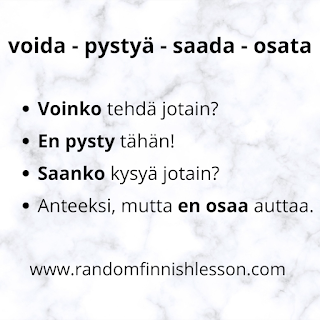
Finnish verbs 'voida, 'pystyä, 'saada' and 'osata'


Voida - to be able to, to 'can' something


  • Mä voin auttaa sua. - I can help you. I have the skill and the time, and there's nothing stopping me from helping you. 
  • Voinko mä tuoda jotain? - Can I bring something?
  • Voitko odottaa vähän aikaa? - Can you wait for a while?
  • Voisitko sä avata oven? - Could you open the door?
  • Notice that voida is also to feel.


Pystyä - almost the same as 'voida'


Pystyä and voida are the same, but sometimes pystyä sounds a little bit stronger. Notice the use of maan infinitive with the second verb.


Saada - to get, to receive


  • Keneltä sä sait tämän? - From whom did you get this?
  • Mä en saanut sitä sähköpostia. - I didn't receive that email. 


Saada - to have a permission


  • Saanko mä sanoa jotain? - May I say something?
  • Saatko sä jo uida? - Are you allowed to swim already?
  • Te ette saa tulla tänne! - You are not allowed to come here.
  • Miksi mä en saa koskaan tehdä mitään kivaa?! - Why can't I ever do anything fun?!


Saada - to get things done


Osata  - to know how to do something, or to master a skill or a language


  • Mä osaan auttaa sua. - I can help you. I know what to do. 
  • Miksi mä en osaa tehdä tätä? - Why can't I do this?
  • Osaatteko te tulla meille? - Do you know how to get to my place?
  • Osaatko sä ranskaa? - Do you know French?


Kiitos, kun luit! Jos pidit postauksesta, voit jakaa sen eteenpäin.
Thanks for reading! If you enjoyed this post, feel free to share it. 
– Hanna

Wednesday, September 17, 2014

Kutsua

Kutsua is one of those verbs with several meanings. The four important forms are kutsua, kutsun, kutsuin and kutsunut. 

to invite

  • Mä en tiedä, kenet mä kutsuisin ensi-iltaan. - I don't know whom I'd invite to the premiere.
  • Kuinka monta vierasta te aiotte kutsua? - How many guests are you going to invite?
  • Kutsuitko sä Jaakon? - Did you invite Jaakko?
  • Miksi sä jätit mut kutsumatta? - Why didn't you invite me?

to call someone something

  • Te voitte kutsua minua Hannaksi. - You can call me Hanna.
  • Millä nimellä sä kutsut sun isoäitiä? - What do you call your grandma?

You might also seen this verb in media a lot lately, as #kutsumua is a campaign against bullying in school.

In spoken language, I'd also use sanoa, to say. The four important forms are sanoa, sanon, sanoin, sanonut.


  • Te voitte  sanoa mua Hannaksi. - You can call me Hanna. 
  • Ei saa sanoa ketään tyhmäksi! - You're not allowed so call anyone stupid!

. . . . . . . . . . . . . . . . . . . .

About the author of this blog:

My name is Hanna Männikkölahti. I am a professional Finnish teacher who gives private online lessons and simplifies books into easy Finnish. You can contact me through www.privatefinnishlessons.com. You can subscribe to this blog from the right-hand banner.