Showing posts with label Tenses - Aikamuodot. Show all posts

Tuesday, April 4, 2017

Sentence starters in Finnish

Whenever you have to say or write your opinion, these phrases might come in handy:

  1. Luin lehdestä, että... I read in the newspaper that....
  2. Olen sitä mieltä, että... - I'm of that opinion that...
  3. Olen varma, että... - I'm sure that...
  4. Ajattelen, että... - I think that...
  5. Luulen, että...  - I think that... (but I'm not sure!)
  6. Olen kuullut, että... - I've heard that...
  7. Olen lukenut, että... - I've read that...
  8. Olen huomannut, että.. - I've noticed that...
  9. Olen kerran nähnyt, kuinka... - I've once seen how...
  10. Olen aina miettinyt, miksi... - I've always wondered why...
  11. On mahdollista, että... - It's possible that...
  12. Voin olla väärässä, mutta... - I may be wrong, but...
  13. Totta puhuen - Telling the truth
  14. Rehellisesti sanottuna - Honestly said

Always useful to review:


About the author of Random Finnish Lesson: 

My name is Hanna Männikkölahti. I am a professional Finnish teacher who gives private online lessons and simplifies books into easy Finnish. Please read more in www.linktr.ee/hannamannikkolahti and follow this blog, if you want to be the first one to know when I post something new.

Sunday, February 7, 2016

Imperfekti - Past tense in Finnish

How to make the past tense in Finnish? Basically, you just add an i or si after the verb stem, before the personal ending. All verb stems end with a vowel. O, u, y and ö stay and i, e and ä go away. A either goes away or turns into o before the past tense i.

Example of the past tense in Finnish


1. o, u and y stay:


  • sanon > sanoin - I say. I said.
  • puhun > puhuin - I speak. I spoke.
  • kysyn > kysyin - I ask. I asked.
  • säilön > säilöin - I preserve. I preserved.

2. a, ä, e and i go away:


  • ostan > ostin - I buy. I bought.
  • heitän > heitin - I throw. I threw.
  • menen > menin - I go. I went.
  • tarvitsen > tarvitsin - I need. I needed.
  • pakenen > pakenin - I escape. I escaped.
  • tanssin = tanssin - I dance. I danced. (Yes, they are the same.)

3. Sometimes a becomes o:


4. With the verb type 2 verbs, the first vowel is dropped when you add i to the stem. 


(Käydä is an exception as käyn becomes kävin in the past tense.)

  • syön > söin - I eat. I ate.
  • juon > join - I drink. I drunk. 
  • vien > vein - I take away. I took away.
  • saan > sain - I get. I got.

5. Finally, all verb type 4 verbs  and some verbs in the verb type 1 have si in the past tense:


  • pakkaan > pakkasin - I pack. I packed.
  • haluan > halusin - I want. I wanted.
  • tykkään > tykkäsin - I like. I liked.
  • tiedän > tiesin - I know. I knew.
  • ymmärrän > ymmärsin - I understand. I understood.
  • lennän > lensin - I flow. I flew. 

p.s. Notice that the third person singular has only one i in the end. Sometimes people accidentally double the i, but don't.

  • hän lähtee > hän lähti - S/he leaves. S/he left.


Kiitos, kun luit! Jos pidit postauksesta, voit jakaa sen eteenpäin.
Thanks for reading! If you enjoyed this post, feel free to share it. 
– Hanna

Monday, December 7, 2015

Past tenses in Finnish

Here's a post about the past tense and the perfect tense in Finnish.

Imperfekti is used when something happened in the past. Sometimes there is a word expressing when it happened, but not necessarily. (Sorry about the misleading name imperfekti. The action might actually be completed.)

  • ostin eilen uuden auton. - I bought a new car yesterday. 
  • Olin ostamassa uutta autoa, kun äiti soitti minulle. - I was in the middle of buying a new car when my mom called me.
  • Luin kirjaa kunnes nukahdin. - I was reading a book until I fell asleep.

Here's when to use perfekti:


1. When the exact time is not so important:


  • Kalle on ostanut uuden auton. - Kalle has bought a new car. (It doesn't matter or I don't know when it happened.)
  • Joku on ostanut kukkia! - Someone has bought flowers! (I can see that there are flowers on the table.)
  • Oletko koskaan käynyt Lontoossa? - Have you ever been to London?

2.  When the action started in the past and still continues, or at least somehow affects the present time:


  • Mitä sä olet ostanut tällä viikolla? - What have you bought this week? (The week is not over yet.)
  • Kuinka kauan sinä olet opiskellut suomea? - For how long have you studied Finnish?

3. With the future tense:


  • Mä soitan kun olen saanut tämän valmiiksi. - I'll call when I've finished this. 
  • Mä lähetän sulle kuvan sitten kun mä olen ostanut uuden takin. - I'll send you a picture after I've bought a new jacket. 

4. When something hasn't happened, but it is still possible to happen:


  • Mä en ole koskaan ostanut ruokaa netistä. - I've never bought food online (But I might do it some day.)
  • Mä en ole vielä lukenut tätä kirjaa. - I haven't read this book yet.


More examples:


Here's how to make the NUT form, and here are more examples to demonstrate the difference:

  • Mä asuin Helsingissä viisi vuotta. - I lived in Helsinki for five years. (I don't live there anymore.)
  • Mä olen asunut Helsingissä viisi vuotta. - I have lived in Helsinki for five years. (And I still live here.)

  • Ostitko sä maitoa? - Did you buy milk? (You just came from the store.)
  • Oletko sä koskaan ostanut netistä ruokaa? - Have you ever bought food online? (In general)

  • Missä sä olit eilen? - Where were you yesterday? (Exact time)
  • Missä sä olet ollut? - Where have you been?

  • Mitä sä söit? - What did you eat?
  • Mitä sä olet syönyt? - What have you eaten? (Your face is a mess and I can see that you have definitely eaten something.)

  • en lukenut tätä kirjaa eilen. - I didn't read this book yesterday. (And yesterday is over so obviously I can't read it yesterday anymore.)
  • Mä en ole lukenut tätä kirjaa. - I haven't read this book. (But it is still possible for me to read it.)

Other things that you might be interested in:


Kiitos, kun luit! Jos pidit postauksesta, voit jakaa sen eteenpäin.
Thanks for reading! If you enjoyed this post, feel free to share it. 
– Hanna

Wednesday, July 29, 2015

Finnish verbs that are the same in present and past

Pay attention to these verbs, because sometimes it might be really confusing that they look the same when conjugated in positive present and past tenses. The list is actually quite long. Whenever there is an i before the infinitive ending, the verb conjugates (almost) the same way in present and past. The verbs are either verb type 1 or 2 verbs. Verb type 2 is always the same. With verb type 1 verbs, the only thing that makes a difference is the third person singular. In other cases, you'll just have to figure out the meaning from the context.

The present conjugation of tanssia:

  • Minä tanssin - I dance
  • Sinä tanssit  - You dance
  • Hän tanssii - S/he dances
  • Me tanssimme - We dance
  • Te tanssitte  - You dance
  • He tanssivat - They dance

The past tense conjugation of tanssia:

  • Minä tanssin - I danced
  • Sinä tanssit - You danced
  • Hän tanssi  - S/he danced
  • Me tanssimme  - We danced
  • Te tanssitte - You danced
  • He tanssivat - They danced

Here are some common verbs that behave the same way:

Verb type 1:
  1. ehtiä - to have time to do something
  2. etsiä - to look for, to search
  3. miettiä - to think in order to find a solution
  4. oppia - to learn
  5. sopia - to agree, to be suit
  6. tanssia - to dance
  7. tutkia - to investigate, to research, to examine
  8. uusia - to renew

Verb type 2: 
  1. analysoida - to analyze
  2. arvioida - to evaluate
  3. imuroida - to vacuum
  4. konsertoida - to have a concert
  5. tupakoida - to smoke
  6. uida - to swim
  7. voida - to be able to


Kiitos, kun luit! Jos pidit postauksesta, voit jakaa sen eteenpäin.
Thanks for reading! If you enjoyed this post, feel free to share it. 
– Hanna

Tuesday, May 6, 2014

How to say that you used to do something in Finnish

I used to is an expression that people seem to need often but which is very different in Finnish. The verb to use is käyttää (käytän, käytin, käyttänyt), but it's only used in sentences like

  • Käytätkö maitoa? - Do you use milk (in your coffee)?
  • Kuka hullu käyttää pitkiä kalsareita toukokuussa?! - What kind of a crazy person wears long underwear in May?!
  • Haluatko sä käyttää mun tablettia? - Do you want to use my tablet computer?
  • Mitäköhän tuo on käyttänyt? - I wonder what he's been taking.

Past tense + ennen


When you want to say what you used to do, just say the sentence in the past tense and add ennen, before:


Oli tapana


If you want to emphasize that you do or did something regularly, you can use minulla on/oli tapana structure. Tapa is a habit, and yes, it is also the imperative form of tappaa. Tapana is the essive case, and it means as a habit.

  • Mulla oli tapana käydä juoksemassa joka aamu. - I used to go running every morning.
  • Meillä oli tapana tehdä perjantaisin pitsaa. - We used to make pizza on Fridays. 
  • Sillä oli tapana iskeä joka ilta joku uusi mies. - She used to pick up some new guy every night. 
  • Onko sulla aina tapana puhua noin? - Do you always speak like that?


Kiitos, kun luit! Jos pidit postauksesta, voit jakaa sen eteenpäin.
Thanks for reading! If you enjoyed this post, feel free to share it. 
– Hanna

Monday, April 7, 2014

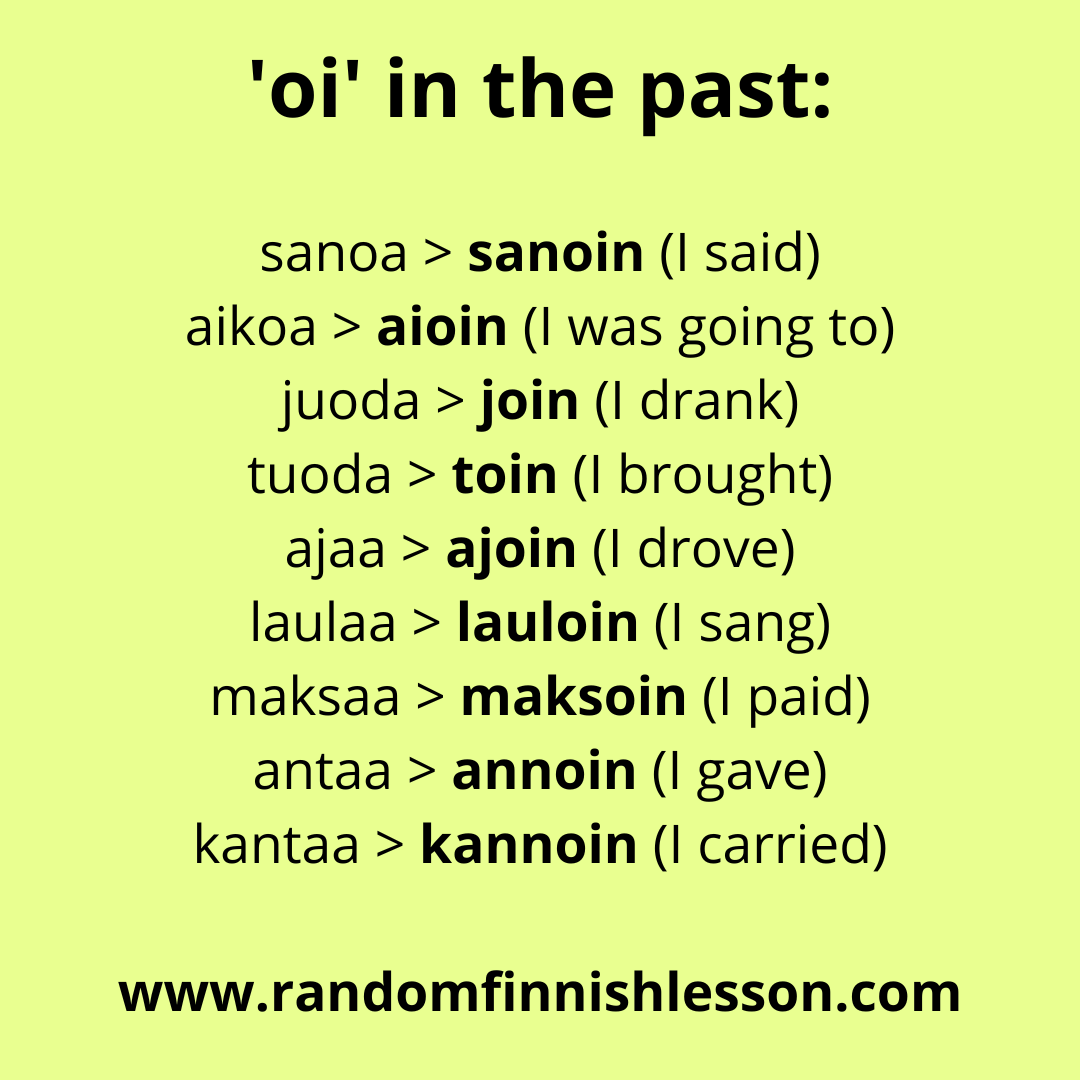
Finnish verbs with 'oi' in the past tense

Here's a post about the verbs that have oi in the past tense. Surprisingly many do.

The verb type 1 verbs that end with oa in the basic form:


  • aikoa: Minä aioin kertoa sinulle. - I was going to tell you. 
  • sanoa: Mitä sinä sanoit? - What did you say?
  • saunoa: Saunoin koko yön. - I was taking sauna all night. 
  • tahtoa: Mitä se tahtoi? - What did he want?


The verb type 2 verbs that end with uoda or oida:


  • juoda: Mitä sinä joit eilen? - What did you drink yesterday?
  • tuoda: Toin sinulle kukkia. - I brought you flowers. 
  • laminoida: Minä laminoin nämä sinulle. - I laminated these for you.

The two-syllable verb type 1 verbs that have the vowel a in the beginning AND in the end of the verb:


  • ajaa: Kuka ajoi? - Who was driving?
  • alkaa: Joko se alkoi? - Did it start already?
  • auttaa: Kiitos, kun autoit. - Thanks for helping. 
  • antaa: Kenelle sinä annoit sen? - Who did you give it to?
  • jakaa: Jaoitko sinä tämän kaikille? - Did you share this with everyone?
  • jaksaa: Kuinka sinä jaksoit tehdä sen? - How did you have the energy to do it?
  • kaataa: Kuka tämän kaatoi? - Who pushed this over?
  • kantaa: Minä kannoin sen ulos. - I carried it outside. 
  • laittaa: Minne mä laitoin ne avaimet? - Where did I put the keys?
  • laulaa: Mitä te lauloitte? - What did you sing?
  • maksaaTämä maksoi tosi paljon. - This cost a lot.
  • saattaa: Minä saatoin olla väärässä. - I might have been wrong. 
  • sataa: Viime kesänä satoi joka päivä. - It rained every day last summer. 
  • vaihtaa: Miksi sinä vaihdoit vaatteet? - Why did you change the clothes?


Kiitos, kun luit! Jos pidit postauksesta, voit jakaa sen eteenpäin.
Thanks for reading! If you enjoyed this post, feel free to share it. 
– Hanna

Saturday, March 8, 2014

How to say negative past tense in Finnish?

The negative past tense is quite a nightmare, mostly because it seems to be hard to remember. You wish it were logical, but it isn't.

There is this:
  • Minä olen. = I am. 
  • Minä en ole. = I am not

And then there is this:
  • Minä olin. = I was.
  • Minä en oli. = I was not. The correct one is Minä en ollut.

Negative past tense in standard Finnish:


  • Minä en sanonut mitään - I didn't say anything.
  • Sinä et sanonut mitään. - You didn't say anything. 
  • Hän ei sanonut mitään. - S/he didn't say anything.
  • Me emme sanoneet mitään. - We didn't say anything. 
  • Te ette sanoneet mitään. - You didn't say anything. 
  • He eivät sanoneet mitään. - They didn't say anything. 


Negative past tense in spoken Finnish:


  • Mä en sanonu mitään. - I didn't say anything.
  • Sä et sanonu mitään. - You didn't say anything. 
  • Se ei sanonu mitään. - S/he didn't say anything.
  • Me ei sanottu mitään. - We didn't say anything. (Hello, passive voice!)
  • Te ette sanonu mitään. - You didn't say anything. 
  • Ne ei sanonu mitään. -  They didn't say anything. 


Here's how to form the active past participle,
also know as the NUT / NYT form. It's very useful to know, because you also use the same form in perfect and pluperfect tenses.


Example sentences of what someone didn't do:


  1. nousta > En noussut sängystä. - I didn't get up from the bed. 
  2. haluta > En halunnut herätä. - I didn't want to wake up.
  3. syödä > En syönyt mitään. - I didn't eat anything. 
  4. juoda > En juonut mitään. - I didn't drink anything. 
  5. avata > En avannut ovea. - I didn't open the door. 
  6. pestä > En pessyt hampaita. - I didn't brush my teeth. 
  7. käydä > En käynyt suihkussa. - I didn't take a shower. 
  8. vaihtaa > En vaihtanut vaatteita. - I didn't change my clothes. 
  9. laittaa > En laittanut ruokaa. - I didn't cook. 
  10. katsoa > En katsonut telkkaria. - I didn't watch tv.
  11. lukea > En lukenut sähköpostia. - I didn't read email. 
  12. viedä > En vienyt roskia. - I didn't take the garbage out. 
  13. skypettää > En skypettänyt mun vanhempien kanssa. - I didn't skype with my parents. 
  14. jutella > En jutellut kenekään kanssa. - I didn't talk to anybody. 
  15. nauraa > En nauranut kertaakaan. - I didn't laugh even once. 
  16. itkeä > En itkenyt. - I didn't cry.
  17. puhua > En puhunut puhelimessa. - I didn't speak on the phone.
  18. mennä > En mennyt minnekään. - I didn't go anywhere. 
  19. siivota > En siivonnut keittiötä. - I didn't clean the kitchen. 
  20. vetää > En vetänyt vessaa. - I didn't flush the toilet. 
  21. imuroida > En imuroinut. - I didn't vacuum. 
  22. moikata > En moikannut naapureita.- I didn't say "Hi" to the neighbours. 
  23. hoitaa > En hoitanut yhtään työasiaa. - I didn't take care of a single work-related matter. 
  24. teettää > En teettänyt valokuvia. - I didn't get pictures printed. 
  25. järjestää > En järjestänyt vaatekaappia. - I didn't organize the clothes closet. 
  26. tehdä > En tehnyt kotitehtäviä. - I didn't do my homework.
  27. kirjoittaa > En kirjoittanut artikkelia.- I didn't write a paper.
  28. opiskella > En opiskellut suomea. - I didn't study Finnish. 
  29. jumpata > En jumpannut jumppapallolla. - I didn't exercise with an exercise ball. 
  30. ehtiä > En ehtinyt. - I didn't have time. 
  31. olla > Minulla ei ollut aikaa. - I didn't have time. 


Lue lisää - Read more


About the author of Random Finnish Lesson: 


My name is Hanna Männikkölahti. I am a professional Finnish teacher who gives private online lessons and simplifies books into easy Finnish. Please read more in www.linktr.ee/hannamannikkolahti and follow this blog, if you want to be the first one to know when I post something new.

Tuesday, March 4, 2014

The passive voice in different tenses

I've noticed that using the passive voice can sometimes be tricky. Many people seem to overuse the verb olla, probably because of the English passive construction, although in Finnish, that's only used when forming the perfect and pluperfect tenses. Minulla on nälkä, so all the examples are with syödä. (The translations are not ideal, but the whole point is to clarify this particular Finnish structure. I also have a post about how to form these passive forms.)

Present tense:


  • syödään = is eaten
  • ei syödä = is not eaten
  • Meidän perheessä päivällinen syödään neljältä. - In our family, the dinner is eaten at four o'clock.
  • Jälkiruokaa ei syödä joka päivä. - The dessert is not eaten every day. (Syödäänpäs! - Yes it is!)

Past tense:


  • syötiin = was eaten
  • ei syöty = was not eaten
  • Mitä koulussa syötiin tänään? - What was eaten in the school today?
  • Me ei syöty mitään. - We didn't eat anything. (Written language: Me emme syöneet mitään.)

Perfect tense:


  • on syöty = has been eaten
  • ei ole syöty = has not been eaten
  • Tämä kakku on syöty melkein kokonaan! -  This cake has been eaten almost completely!
  • Miksi tätä keittoa ei ole syöty? - Why hasn't this soup been eaten?

Pluperfect tense:


  • oli syöty = had been eaten
  • ei ollut syöty = had not been eaten
  • Kun tulin kotiin, kaikki laskiaispullat oli jo syöty. - When I came home, all the Shrove buns had already been eaten.
  • Löysin vain yhden surkean pullan, jota ei ollut syöty. - I found only one lousy bun that had not been eaten.

The confusing part:


 In spoken language, we use a double passive in the perfect and pluperfect tenses: 
  • Mä löysin vain yhen surkeen pullan, jota ei oltu syöty.  

Actually, here are all the forms in spoken language and written language.

Present tense:

  • Me syödään. = Me syömme. = We eat.
  • Me ei syödä. = Me emme syö. = We don't eat.

Past tense:

  • Me syötiin. = Me söimme. = We ate.
  • Me ei syöty. = Me emme syöneet. = We didn't eat.

Perfect tense:

  • Me on syöty. / Me ollaan syöty. = Me olemme syöneet. = We have eaten.
  • Me ei oo syöty. / Me ei olla syöty. = Me emme ole syöneet. = We haven't eaten.

Pluperfect tense:

  • Me oli syöty. / Me oltiin syöty. = Me olimme syöneet. = We had eaten.
  • Me ei oltu syöty. = Me emme olleet syöneet. = We hadn't eaten. 

(I can't help feeling that I should apologize this on behalf of all the Finns. Anteeksi.)


About the author of Random Finnish Lesson: 


My name is Hanna Männikkölahti. I am a professional Finnish teacher who gives private online lessons and simplifies books into easy Finnish. Please read more in www.linktr.ee/hannamannikkolahti and follow this blog, if you want to be the first one to know when I post something new. 

Sunday, September 22, 2013

Talking about the future in Finnish

..is super easy: just use the present tense! However, here are some ways to emphasize that you are talking about the future, not present:

1. Time adverbs and conjunctions


  • Mä teen sen huomenna. - I'll do it tomorrow. 
  • Mä menen ensi viikonloppuna Helsinkiin. - I'm going to Helsinki next weekend. 
  • Mä soitan sulle, kun mä olen perillä. - I will call you when I'm there. 

2. Future verbs aikoa and meinata


  • Mä aion ostaa uuden auton. - I'm intending to buy a new car. 
  • Mitä sä meinaat tehdä huomenna? - What are you planning to do tomorrow?

3. Using a present and a perfect tense together in a sentence


  • Mä soitan sulle kun putkimies on lähtenyt. - I will call you when the plumber has left. 
  • Vastaan sinulle sitten kun olen lukenut tämän sopimuksen. - I will answer you once I've read this contract. 

4. Using the verb tulla and the MA-infinitive illative


  • Sinä tulet katumaan tätä! - You will regret this!
  • En tule ikinä antamaan sinulle anteeksi. - I will never forgive you. 
  • Kuinka monta kurssia sinulla tulee olemaan ensi syksynä? - How many courses will you have next fall?


Kiitos, kun luit! Jos pidit postauksesta, voit jakaa sen eteenpäin.
Thanks for reading! If you enjoyed this post, feel free to share it. 
– Hanna