Showing posts with label Spoken language - Puhekieli. Show all posts

Wednesday, July 12, 2023

Expanding your Finnish vocabulary with Gettomasa rap songs

If you like Finnish rap, or if you have kids in Finland, you have probably heard of Gettomasa. 

If you listen to the songs on Spotify, you can usually read the lyrics at the same time. Notice that depending of the source, the spelling might vary as in grindata/graindata or with other loan words from English. 

I have a post about spoken Finnish, but understading rap lyrics might require more specific vocabulary. Urbaani sanakirja is great, and you might also want to check out the grammar of swearing in Finnish

The words on the list are from these songs: 


Gettomasa Jyväskylässä 12.7.2023.
Kello on viisitoista yli yksitoista, 
ja ulkona on näin valoisaa.


Nouns


  1. duuni
  2. chanssi
  3. hima
  4. jengi
  5. jäbä
  6. kiesi
  7. kundi
  8. lande
  9. leija
  10. luuri
  11. massi
  12. meitsi
  13. muija
  14. plääni
  15. rafla
  16. rundi
  17. skidi
  18. Stadi
  19. yläfemma


Verbs


  1. ballata
  2. chillata
  3. delata 
  4. fiilata
  5. grindata
  6. heitata
  7. koodata
  8. repata
  9. rokata
  10. smoukata
  11. tsiigata
  12. venata


Adverbial phrases


  1. tikissä
  2. mintissä
  3. messissä


Here are the translations. I hope I got them right. :)


Nouns


  1. duuni - work
  2. chanssi - a chance
  3. hima - home
  4. jengi - a gang, people
  5. jäbä - a boy, a man
  6. kiesi - a car
  7. kundi - a boy, a man
  8. lande - countryside, or a person from there
  9. leija - a boaster, very nice, probably also very expensive (Normally leija is a kite. It can also be a fart, but in rap songs, it probably isn't.) 
  10. luuri - a phone
  11. massi - money
  12. meitsi - me, I
  13. muija - a woman, a girl (but not everyone likes this, so be careful if using it. If you want to talk about your girlfriend, here are some options.)
  14. plääni - a plan
  15. rafla - a bar, a restaurant
  16. rundi - a tour, a round
  17. skidi - a kid, a child
  18. Stadi - Helsinki, Helsinki city center
  19. yläfemma - a high five


Verbs 


  1. ballata - to spend a lot of money
  2. chillata - to chill
  3. delata - to die
  4. fiilata - to feel, to like, to know the feeling
  5. grindata - to work hard
  6. heitata - to hate
  7. koodata - to message
  8. repata - to represent
  9. rokata - to rock, to wear something
  10. smoukata - to smoke
  11. tsiigata - to look
  12. venata - to wait


Adverbial phrases


  1. tikissä - in good shape
  2. mintissä - in mint condition, in good shape (I have no idea which one is better.)
  3. messissä - along, with

Read more


About the author of Random Finnish Lesson: 

My name is Hanna Männikkölahti. I am a professional Finnish teacher who gives private online lessons and simplifies books into easy Finnish. Please read more in www.linktr.ee/hannamannikkolahti and follow this blog, if you want to be the first one to know when I post something new.

Thursday, May 11, 2023

Learn Finnish with Käärijä's Cha Cha Cha

If you haven't seen and heard Käärijä's Cha Cha Cha yet, check out the song immediately to know what's going on at the Eurovision song contest. You can read the translation on Lyricstranslate.com. As I'm writing this, there are already 32 different languages available!
 
Here are the lyrics with links to suitable blog posts: 

Käärijä: Cha Cha Cha


Pidän kaksin käsin kiinni juomista niinku
Cha, cha, cha, cha, cha, cha, cha, ei
En mieti huomista ku tartun tuopista niinku
Cha, cha, cha, cha, cha, cha, cha, ei
Haluun olla sekasin ja vapaa huolista niinku
Cha, cha, cha, cha, cha, cha, cha, ei
Ja mä jatkan kunnes en enää pysy tuolissa niinku

 
Muutama piña colada on jo takana
Silti mul on vielä naamataulu vakava, yeah, yeah, ye, ye, yeah
Ilta on vielä nuori ja aikaa kumota
Tää jäinen ulkokuori on aika tuhota
Parketti kutsuu mua ku en oo enää lukossa
Niinku cha cha cha mä oon tulossa

Pidän kaksin käsin kiinni juomista etc.
 
 
Cha, cha, cha, toinen silmä jo karsastaa
Ja puhe sammaltaa ku tää toinen puoli must vallan saa
Cha, cha, cha, en oo arkena tää mies laisinkaan
En oo mut tänään oon se mies, tänään oon se mies

 
Nyt lähden tanssimaan etc.


🟢🟢🟢 Onnea Euroviisuihin, Käärijä! 💚🟢🟢🟢


Edit: Käärijä came in second place, with a Finnish language song! 

You can watch Euroviisut here and listen to the songs with Finnish subtitles: https://areena.yle.fi/tv/ohjelmat/57-mW7OY44xJ?t=euroviisut


Kuva: Mikke Pöyhönen (Warner Music Finlandin kuvapankki)


About the author of Random Finnish Lesson 


My name is Hanna Männikkölahti. I am a Finnish teacher who gives private online lessons and simplifies books into easy Finnish. Please read more in www.linktr.ee/hannamannikkolahti and follow this blog, if you want to be the first one to know when I post something new. Thanks for reading my blog!

Sunday, April 16, 2023

Finnish podcasts about politics

Here's a list of different podcasts that discuss Finnish politics and daily topics. Leave a comment, if I should add something to this list. 


Ykkösaamu

  • A daily Yle podcast about current issues. Approximately 50 minutes per episode. 


Uutispodcast

  • Two Yle jounalists talking about daily topics with guests. A new 20-minute episode every weekday.

Politiikan puskaradio 

  • Iltalehti journalists talking about politics.

Politiikkaradio

  • Three Yle journalists talking about politics with guests. Approximately 30 minutes per episode.

Maailmanpolitiikan arkipäivää

  • A weekly podcast about world politics.


Muita hyödyllisiä linkkejä, other useful links: 


Thanks for reading! If you enjoyed this post, feel free to share it. 
Kiitos, kun luit! Jos pidit postauksesta, voit jakaa sen eteenpäin.
– Hanna

Tuesday, February 22, 2022

Random Finnish Lesson Podcast

Here's a small reminder about my Random Finnish Lesson podcast.

You can listen to it through


Some of my interviews  are also available 
on YouTube
This one is with my friend and colleague


Thanks for reading! If you enjoyed this post, feel free to share it. 
Kiitos, kun luit! Jos pidit postauksesta, voit jakaa sen eteenpäin.
Hanna


Thursday, October 28, 2021

Tonnin seteli and other Finnish comedy classics by Kummeli

You might have seen this Tonnin seteli picture in a meme: 

Tonnin seteli - A thousand mark banknote


Tonnin seteli is a super popular sketch about a guy who doesn't get enough money back after buying his small cup of coffee and a wafer. Here's a script of the sketch: 

Asiakas: Moi. 
Myyjä: Hei.
Asiakas: Pieni kahvi. 
Myyjä: Tuleeko muuta?
Asiakas: Tommonen vohveli tosta. 
Myyjä: Kahdeksan markkaa.
Asiakas: Jaha niin. Mulla ei ookaan kun tällanen iso seteli. 
Myyjä: Ja tuhanteen. 
Asiakas: Mähän annoin sulle tonnin setelin. Eiks se ollut tonnin seteli? Tonni. Enks mä antanut tonnin? Mä annoin sulle tonnin setelin. Eiks se ollu tonnin seteli? Eikö se ollut? Mä annoin sulle tonnin setelin. Mä annoin tonnin setelin. Tonnin seteli. 


Normipäivä - Just a normal day


Another Kummeli classic is Normipäivä. It's about three guys in a bar after they've been playing tennis. This is what they ask each other during the evening: 

- Onks sulla mitään huomenna? - Do you have anything tomorrow?
- Millainen päivä sulla on huomenna? - What kind of a day do you have tomorrow?


You can watch Normipäivä here: 


Watch more if you can:


About the author of Random Finnish Lesson: 


My name is Hanna Männikkölahti. I am a professional Finnish teacher who gives private online lessons and simplifies books into easy Finnish. Please read more in www.linktr.ee/hannamannikkolahti and follow this blog, if you want to be the first one to know when I post something new. 

Friday, February 7, 2020

Confusing spoken language expressions

These words are perfectly good standard Finnish, but they also mean something else in colloquial Finnish. Do you know the two meanings? And do you know more words like this? Please leave a comment and I'll update this post.

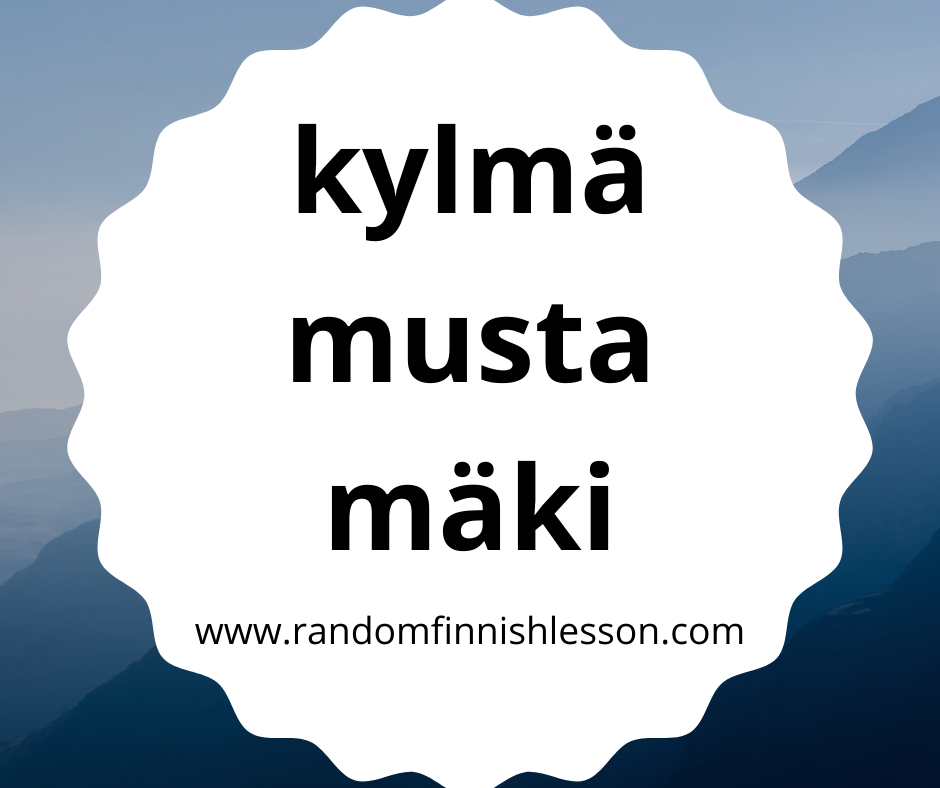
  1. kylmä
  2. musta
  3. mäki


  1. kylmä - cold / kyllä minä = indeed I
  2. musta - black / minusta = in my opinion, out of me, me becoming something
  3. mäki - a hill / minäkin = me too

Here are sentences with both expressions:

  1. Kylmä luulen, että siellä on tänään kylmä.  - Indeed I think that it's cold out there today.
  2. Musta musta sopii mulle. - I think that the colour black looks good on me. 
  3. Mäki tiiän, missä se mäki on. - I know too where the hill is. 

Lue lisää: 


Kiitos, kun luit! Jos pidit postauksesta, voit jakaa sen eteenpäin.
Thanks for reading! If you enjoyed this post, feel free to share it. 
– Hanna


Wednesday, September 11, 2019

Intensive Finnish course in January 2020

Mitä teet tammikuussa?
Tule Jyväskylän kesäyliopiston
intensiivikurssille Jyväskylään!
Kurssi järjestetään tammikuun 8.-17. päivä.
Minä olen yksi kurssin opettajista.

Kurssin hinta on 425 €,
mutta jos ilmoittaudut ennen 1. marraskuuta,
hinta on 375 €.
Hinta ei sisällä majoitusta.
Voit asua hotellissa, hostellissa
tai jonkun jyväskyläläisen kotona.

Oppitunnit pidetään Seminaarinmäen kampuksella, 
aivan AaltoAlvari-uimahallin vieressä.

Tässä on lisätietoa kurssista suomeksi ja englanniksi: https://kesayo.jyu.fi/fi/opintotarjonta-uusi/suomen-kielen-intensiivikurssit-finnish-intensive-courses/suomea_talvella


Hiihtoa kylmässä ja pimeässä.

Kävelyä sumussa.


p.s. Oletko kiinnostunut yrittäjyydestä?

Haluaisitko joskus perustaa oman firman?
Lahden ammattikorkeakoulu järjestää ilmaisen verkkokurssin maahanmuuttajille,
joilla on korkeakoulututkinto ja vähintään A2.2-tason suomen kielen taito.
Lue lisää täältä: https://randomfinnishlesson.blogspot.com/2019/09/yrittajakoulutusta-maahanmuuttajille.html
Hakuaika loppuu 15.10.2019.


. . . . . . . . . . . . . . . . . . . . .

About the author of this blog:

My name is Hanna Männikkölahti, and I am a native Finn who gives private lessons via Skype and simplifies books into easy Finnish. Please leave a comment, if you have something to ask about Finnish or novels in easy Finnish.


Lue lisää selkokirjoistani: www.hannamannikkolahti.com

Wednesday, May 29, 2019

Three short films in Finnish - Kolme suomenkielistä lyhytelokuvaa

Tämä on pieni postaus kolmesta lyhytelokuvasta.
En kirjoita tämän enempää, koska haluan,
että katsot nämä elokuvat.
Muista laittaa tekstitys päälle!

Pahoittelen, jos nämä eivät näy sinun kotimaassasi.
Aika usein Yle Areena näkyy vain Suomessa.


Klikkaa kuvaa niin näet kaikki Yle Areenan lyhytelokuvat.


. . . . . . . . . . . . . . . . . . . . .

About the author of this blog:

My name is Hanna Männikkölahti, and I am a native Finn who gives private lessons via Skype and simplifies books into easy Finnish. Please leave a comment, if you have something to ask about Finnish or novels in easy Finnish. 


Lue lisää selkokirjoista: https://privatefinnishlessons.com/books/

Sunday, August 19, 2018

Selkosunnuntai 34 - Suomen kielen ääntämisestä

Hyvää selkosunnuntaita! 

Tänään minulla on kirjoittajavieraana Mari Nikonen. 
En ole vielä koskaan tavannut Maria, 
mutta olen kirjoitellut hänen kanssaan Facebookissa. 

Kiitos kirjoituksesta, Mari!


Minä olen Mari Nikonen.
Olen suomen kielen opettaja ja suomen kielen tutkija.
Opetan suomea Helsingissä.
Minulla on blogi Ask a Finnish Teacher.
Blogissa vastaan englanniksi
suomen kielen opiskelijoiden kysymyksiin.

Tänään kirjoitan siitä,
miten voit oppia ääntämään
ja ymmärtämään suomea paremmin.
Olen kirjoittanut yhdessä Eija Ahon ja Aino Huhtaniemen kanssa kirjan.
Kirjan nimi on Fonetiikkaa suomen kielen oppijoille.

Kirjan teemoja ovat esimerkiksi suomen kielen vokaalit,
konsonantit, intonaatio ja rytmi.
Kirjassa on myös paljon tietoa siitä,
miten voi oppia ääntämään paremmin.

Fonetiikkaa suomen kielen oppijoille ei ole selkokirja,
mutta se on vähän helpompi kirja.
Jos luetun ymmärtämisen tasosi on B2,
sinun on tosi helppo lukea sitä.


Kirjassa on myös tosi paljon kuvia.
Voit saada kaiken informaation katsomalla kuvia.
Voit ostaa kirjan esimerkiksi Booky-kirjakaupasta.

Nyt teemme Ainon, Eijan
ja Päivi Virkkusen kanssa uutta harjoituskirjaa,
mutta se ei ole vielä ihan valmis.
Tosi hyvä kirja ääntämisen oppimiseen on Mitä kuuluu?
Mitä kuuluu? -kirjassa on paljon harjoituksia äänteistä.
Meidän uudessa kirjassamme on paljon tehtäviä
intonaatiosta ja rytmistä.
Siinä on paljon enemmän puhekieltä kuin vanhoissa kirjoissa.

Ääntämisen opiskelussa tärkeää on kuunteleminen ja matkiminen.
On hyvä idea yrittää imitoida.
Näyttele, että olet sama ihminen, joka puhuu.
Älä pelkää hassutella!
Toista monta kertaa.
Älä säikähdä, jos ensin tuntuu vaikealta.


Tässä on esimerkki tehtävästä,
jolla voit harjoitella suomen intonaatiota ja rytmiä.

1. Valitse tosi lyhyt äänite, jonka ymmärrät.


Sopiva pituus on esimerkiksi 5 sekuntia.
Ihan ensin kuuntele se tosi monta kertaa.
Yritä toistaa perässä.

2. Kuuntele melodiaa.


Kun puhumme suomea,
aloitamme usein ylhäältä ja lopetamme alas.
Onko tässä niin?
Missä on korkein kohta?
Entä matalin?
Yritä toistaa melodia.

3. Kuuntele rytmiä.


Suomessa on usein tosi tasainen rytmi.
Onko tässä tasainen rytmi,
vai onko jokin kohta nopeampi?
Yritä toistaa rytmi samanlaisena.
Taputa rytmi.

4. Äänitä itseäsi ja vertaa alkuperäiseen äänitteeseen. 


Kuuntele itseäsi tarkkaan.
Kuulostatko samalta?
Hyvä työkalu ääntämisen opiskeluun on Dublearn,
Se on sovellus sekä Androidille että iPhonelle. 
Dublearniin voi ladata videoita ja dubata niitä itse.
Kun opiskelet ääntämistä,
se auttaa sinua myös kuullun ymmärtämisessä.
Ei ole niin tärkeää,
millä aksentilla puhut.
Tärkeää on,
että tunnet suomen kielen äänteet,
intonaation ja rytmin hyvin.
Sitten voit itse päättää,
millaisella aksentilla haluat puhua.
Jos haluat,
voit tehdä tosi paljon töitä
ja opiskella suomalaisen aksentin.

. . . . . . . . . . . . . . . . . . . .

About the author of this blog:

My name is Hanna Männikkölahti. I am a professional Finnish teacher who gives private online lessons and simplifies books into easy Finnish. You can contact me through www.privatefinnishlessons.com. You can subscribe to this blog from the right-hand banner. 


Monday, March 5, 2018

Easy Finnish podcast challenge

Here's a challenge of the week for you: Listen to my simple Finnish podcast, only one episode a day! I have chosen you seven different episodes from my channel. As you might have noticed, I have no special skills in audio anything, I just record the episode on my phone or with Audacity, choose a picture that has something to do with the topic, write a short description, and publish it online. I know I still have a lot to learn, and I should really speak slowlier, but I'm learning.


Please let me know what you would like to hear next! I can also try to interview a famous person and then write a story for Selkosanomat.

https://www.mixcloud.com/RandomFinnishLesson


About the author of Random Finnish Lesson: 


My name is Hanna Männikkölahti. I am a professional Finnish teacher who gives private online lessons and simplifies books into easy Finnish. Follow this blog, if you want to be the first one to know when I post something new. If you want to subscribe to my newsletter, you can do it here
Thursday, August 10, 2017

Finnish slang words

Here's a list of words that I just heard in a radio show. (EDIT: I have heard them before, and most of the expressions are quite old, but I just happened to hear an interview where they were used.)  I understand all of them, but I don't think that I would ever use them in my normal speech. I'm a 40+ years old woman who has lived in Jyväskylä for the past 20 years, and before that I lived in Seinäjoki, so I don't really speak like the twenty-something young adults from Helsinki. (It's totally OK if someone else does! :)) Do you know what these words mean?

  1. duuni
  2. digata
  3. faija
  4. fiilis
  5. hima
  6. jengi
  7. leveli
  8. mutsi
  9. rela
  10. spessu


Here are the explanations and translations:

  1. duuni = työ - a work
  2. digata = kannustaa, tykätä jostain - to dig
  3. faija = isä - dad
  4. fiilis = tunnelma - a feeling
  5. hima = koti - a home
  6. jengi = ihmiset - the gang, the people
  7. leveli = taso - a level
  8. mutsi = äiti - mom
  9. rela = rento - relaxed
  10. spessu = erikoinen, erityinen - special

If I have no clue what people are saying, I check the words from Urbaani sanakirja. If you are interested in the slang that many people use in Helsinki, you might like Stadin slangi ry page.


Kiitos, kun luit! Jos pidit postauksesta, voit jakaa sen eteenpäin.
Thanks for reading! If you enjoyed this post, feel free to share it. 
– Hanna

Wednesday, July 12, 2017

Finnish idioms

Here are some common idioms that I actually use. Do you know what they mean and when to use them?

  1. Mulla on tässä asiassa oma lehmä ojassa.
  2. Mä opin sen kantapään kautta.
  3. Se elää kädestä suuhun.
  4. Sun täytyy vain ottaa itseäsi niskasta kiinni.
  5. Tämä oli kyllä rimanalitus!
  6. Olipa onni onnettomuudessa, että juna oli myöhässä.
  7. Pysytkö sä kärryillä?
  8. Mä en ole nyt kartalla.
  9. Se ei ole pannut tikkua ristiin!
  10. Kuinka sä voit katsoa tätä läpi sormien?
  11. Toivottavasti se ei vedä hernettä nenään.
  12. Tämä tuli ihan puskista!
  13. Mua huijattiin kuusi nolla. 
  14. Mikko teki minulle karhunpalveluksen. 

Edited in 2025:
This is the first picture that I've ever asked from ChatGPT!
Oma lehmä ojassa = Own cow in the ditch


Translations and explanations: 

  1. Mulla on tässä asiassa oma lehmä ojassa. - I have my own cow in the ditch in this matter. It's in my own interest. (If my own cow is in the ditch, I'm more likely to get out of there than if it was just my neighbour's cow!)
  2. opin sen kantapään kautta. - I learned it through the heel. I learned it the hard way.
  3. Se elää kädestä suuhun. - He lives from hand to mouth. He lives with just enough money to cover immediate needs.
  4. Sun täytyy vain ottaa itseäsi niskasta kiinni. - You just have to grab yourself from the neck. You just have to pull yourself together.
  5. Tämä oli kyllä rimanalitus! - This was definitely a below the bar performance! This was a poor performance.
  6. Olipa onni onnettomuudessa, että juna oli myöhässä. - What a luck in the accident / misfortune it was that the train was late. At first, it seemed bad that the train was late, but it turned out to be good.
  7. Pysytkö sä kärryillä? - Can you stay on / not fall down from the wagon? Do you understand and keep up with what’s being explained?
  8. Mä en ole nyt kartalla. - I'm not on the map right now. I don’t understand what’s happening.
  9. Se ei ole pannut tikkua ristiin! - He has not put a stick into a formation of an x / a cross. He hasn’t done anything.
  10. Kuinka sä voit katsoa tätä läpi sormien? - How can you look at this through your fingers? How can you ignore this problem?
  11. Toivottavasti se ei vedä hernettä nenään. - I hope that he won't inhale a pea into his nose. I hope he doesn’t get upset. (Having a pea in your nose is not pleasant!)
  12. Tämä tuli ihan puskista! - This came absolutely from the bushes! This happened unexpectedly.
  13. Mua huijattiin kuusi nolla. - I was fooled six to zero. I was totally fooled.
  14. Mikko teki minulle karhunpalveluksen. - Mikko did me a bear's favour. Mikko tried to help but actually made things worse. (From this fable!)


P.S. When is the last time you read a book in easy Finnish? If you neew some help with reading, join my online course about 'Juurihoito'! You can start the course any time you want to.


Related posts: 


Kiitos, kun luit! Jos pidit postauksesta, voit jakaa sen eteenpäin.
Thanks for reading! If you enjoyed this post, feel free to share it. 
– Hanna

Monday, December 7, 2015

What is the difference between 'vain' and 'vasta'?

Someone suggested this topic in another postKiitos ideasta! Vain is only. Vasta can mean many different things but usually is not until or not yet. It is also vihta, the thing in the sauna.


Vain


  • Minulla on vain kaksi euroa. - I have only two euros. 
  • Ei kiitos, en tarvitse apua. Minä vain katselen. - No thank you, I don't need any help. I'm just looking around. 
  • Miksi sinulla on vain sukat jalassa? - Why are you wearing nothing but socks?

Notice that in spoken language, vain is often vaan:

  • Mulla on vaan kaks euroo. - I have only two euros. (Don't mix it with the other vaan.)

Vasta


  • Minulla on vasta kolme Muumimukia. -  I have only three Moomin mugs. (But I'm going to get more!)
  • Oletko sinä vasta 30? - Are you only thirty years old?
  • Tulin kotiin vasta neljältä. - I didn't come home until four o'clock.
  • Miksi tänään on vasta maanantai eikä perjantai! - Why is it Monday today and not already Friday!

Kiitos, kun luit! Jos pidit postauksesta, voit jakaa sen eteenpäin.
Thanks for reading! If you enjoyed this post, feel free to share it. 
– Hanna

Wednesday, November 18, 2015

Spoken language words that my kids use

Here are some spoken language words that my 3- and 6-year-old children use. Do you know what they mean?

  1. futis
  2. hyvis
  3. jäbä
  4. koklata
  5. lippis
  6. mäsä
  7. pahis
  8. papru
  9. peba
  10. polttis
  11. säbä
  12. sykky
  13. teeppari
  14. vaklata

Here are the translations and the origins of the spoken language words:

  1. futis < football - football
  2. hyvis < hyvä - a good character
  3. jäbä < jätkä - a dude
  4. koklata < kokeilla - to try
  5. lippis < lippalakki - a cap
  6. mäsä < (I have no idea what's the origin is!) - broken
  7. pahis < paha - a bad guy
  8. papru < paperi - a paper
  9. peba < peppu - a butt
  10. polttis < polttopallo - dodge ball
  11. säbä < sähly - floor ball
  12. sykky < syli - a lap
  13. teeppari < t-paita - a t-shirt
  14. vaklata < vakoilla - to spy

Sunday, September 27, 2015

Finnish at work

This is a post written by my students! I gave them a list of different situations at work and asked them to think what to say in Finnish. Here's what they came up with:

When you didn't understand something:

  • Voisitko neuvoa minulle, kuinka tämä tehdään? - Could you advise me how this is done? (Spoken language: Voisiksä neuvoa mulle, kuinka tää tehään?)
  • Anteeksi, mutta voisitko selittää, mitä tarkoitat? - Excuse me, but can you explain what you mean? (Spoken language: Voisiksä selittää mitä sä tarkotat?)
  • Anteeksi, voisitko toistaa? - Excuse me, can you please say it again? (Spoken language: Voisiksä sanoa uudelleen?)
  • En ymmärtänyt tehtävää. Voitko selittää sen uudelleen? - I didn't understand the task. Can you please explain it again? (Spoken language: Mä en ymmärtänyt. Voiksä selittää uudelleen?)

Disagreeing:

  • Mielestäni tämä asia pitäisi tehdä eri tavalla.- In my opinion, this thing should be done differently. (Spoken language: Mun mielestä tää juttu pitäis tehä eri tavalla.)
  • Anteeksi, mutta voinko sanoa jotain? Sinä teit tuon väärin. - Excuse me, but can I say something? You did that wrong. (Spoken language: Anteeks mutta saanko mä sanoa jotain? Sä teit ton väärin.)
  • Oletko varma että se tehdään noin? - Are you sure that it's done like that? (Spoken language: Ooksä varma, et se tehään noin?)

Complaining:

  • Sinä olet aina myöhässä. Sinun pitäisi tulla ajoissa. - You are always late. You should come on time. (Spoken language: Sä oot aina myöhässä. Sun pitäis tulla ajoissa.) 
  • Voisitko tulla ajoissa töihin?- Can you please come to work at in time? (Spoken language: Voisiksä tulla ajoissa töihin?)

 What to say when your friend isn't feeling well:

  • Onko kaikki hyvin? - Is everything okay? (Spoken language: Onks kaikki hyvin?)
  •  Voinko auttaa jotenkin? - Can I help you somehow? (Spoken language: Voinksmä auttaa jotenki?) 

Sunday, March 8, 2015

Spoken Finnish (puhekieli) tips

Here are some tips for spoken language. Notice that not everybody speaks like this, and it is totally ok to use the standard Finnish, if you want. However, these tips might help you to understand what (some) Finns say. The pronouns might be different depending on where you live, and many things depend on the local dialect

Pronouns


  • Say 'se' instead of 'hän' (it, s/he).
  • Say 'toi' instead of 'tuo' (that).
  • Say 'tää' instead 'tämä' (this).
  • Use the verb's singular form in the third person. Say 'ne on' instead of 'he ovat' and 'ne tulee' instead of 'he tulevat'. (They are. They come.)
  • Use the personal pronouns. You can say things like 'Asun Helsingissä', but usually we'd say 'Mä / mää / mie / miä / minä asun Helsingissä.' (I live in Helsinki.
  • Say 'Se on vaan joku kirja' and  'Se on jonkun puiston vieressä' instead of 'Se on vain jokin kirja' and 'Se on jonkin puiston vieressä.' (It's just some book. It's next to some park.)
  • Say 'Se on jollain muulla.' instead of 'Se on jollakulla muulla.' (Someone else has it.)
  • Say 'Kysy joltain muulta' instead of 'Kysy joltakulta muulta.' (Ask someone else.)
  • Say 'Anna se jollekin muulle.' instead of 'Anna se jollekuulle muulle.' (Give it to someone else.)

Verb forms


  • Forget the vat ending and just use the singular thrird person conjugation: he ovat = ne on, he olivat = ne oli, he ovat olleet = ne on ollu. (they are, they were, they have been)
  • Say me ollaan instead of me olemme and me oltiin instead of me olimme.  (we are, we were)
  • Say me ei olla instead of me emme ole and me ei oltu instead of me emme olleet. (we aren't , we weren't)  
  • Ask Mitä me tehtäis? instead of Mitä me tekisimme? (What shall we do? What would we do?)


Pronunciation


  • Drop the d and say kaheksan, yheksän, nähään, tehään and ootan instead of kahdeksan, yhdeksän, nähdään, tehdään and odotan. (eight, nine, See you, Let's do, I wait)
  • Don't be so careful with the pronunciation of two different vowels in a row. Say maitoo, juustoo, kinkkuu, vihree and  pehmee instead of maitoa, juustoa, kinkkua, vihreä and pehmeä. (some milk, some cheese, some ham, green and soft)
  • Don't be so careful with the endings. Some people say Helsingis instead of Helsingissä. Että is et, mutta is mut, sitten is sit, and so on. (that, but, then)

Other features


  • Possessive suffixes are not really used in spoken language. What is kirjani is standard Finnish is usually mun, miun, or minun kirja in spoken Finnish. Now that I think of it, the only time I do use possessive suffixes is in expresssions like mun tietääkseni, as far as I know.
  • Say 'vaan' instead of 'vain' (only).
  • Say 'ku' instead of 'kuin' (than).


Hyödyllisiä linkkejä - Useful links:


Thanks for reading! If you enjoyed this post, feel free to share it. 
Kiitos, kun luit! Jos pidit postauksesta, voit jakaa sen eteenpäin.
– Hanna