Showing posts with label Grammar - Kielioppi. Show all posts

Saturday, October 11, 2025

All my posts about the Finnish object

I have several posts that have something to do with the Finnish object:


More Finnish grammar: 


Kiitos, kun luit! Jos pidit postauksesta, voit jakaa sen eteenpäin.
Thanks for reading! If you enjoyed this post, feel free to share it. 
– Hanna

Tuesday, June 24, 2025

What's with the Finnish expression 'ei välttämättä'?

Have you seen or heard the expression ei välttämättä?  It means not necessarily. 

  • Välttää is to avoid something. 
  • Välttämättä is a ma infinitive in abessive, so literally it means without avoiding.  


Example sentences with ei välttämättä:


  • Teidän ei välttämättä tarvitse tulla. - You don't necessarily have to come.
  • Tämä ei ole välttämättä ainoa oikea vastaus. - This is not necessarily the only correct answer.
  • A fun fact: in spoken Finnish, it's ei välttis.


You can also make an adjective and another verb from välttää:

  • The adjective välttämätön means necessary. (If you want to say unavoidable, that would be väistämätön.)
  • The frequentative verb vältellä is to avoid something multiple times, to keep avoiding.


Example sentences with välttää, vältellä and välttämätön: 


  • Yritän välttää virheitä. - I try to avoid mistakes. 
  • Vältteletkö sinä minua? - Are you avoiding me?
  • Onko tämä välttämätöntä? - Is this necessary?
  • Onko meidän välttämätöntä osallistua? - Is it necessary for us to participate?


Oh, what is the difference between these Do I have to come questions? 


  • Onko minun pakko tulla? is the strongest because of the word pakko. 
  • Täytyykö minun tulla? and Pitääkö minun tulla? are the same.
  • Onko minun välttämätöntä tulla? sounds the most formal because of the word välttämätön. :)

You might also like How to say without in Finnish.

P.S. If you are looking for a fun self-study course, check out my 'Juurihoito' Online Course!


Kiitos, kun luit! Jos pidit postauksesta, voit jakaa sen eteenpäin.
Thanks for reading! If you enjoyed this post, feel free to share it. 
– Hanna

Tuesday, June 11, 2024

How to say only, just and exactly in Finnish

I've noticed that sometimes Finnish learners say 'just' when they should say 'vain' (or 'vaan' in colloquial Finnish). It's understandable, because sometimes the Finnish 'just' does mean the same as the English 'just'. However, it's not always like that. 

vain = only, just


  • Minä söin vain leipää. - I ate only bread.
  • Colloquial Finnish: Mä söin vaan leipää. - I ate only bread. 
  • Notice that 'vain' is vaan in colloquial Finnish. 


juuri = just, recently


  • Minä söin juuri leipää. - I was eating bread just now.
  • Colloquial Finnish: Mä söin just leipää. - I was eating bread just now. 
  • Notice that 'juuri' is 'just' in colloquial Finnish. So here 'just' means the same in both languages!


    juuri = exactly


    • Se on juuri tämä. - It's exactly this one. 
    • Colloquial Finnish: Se on just tää. - It's exactly this one. 
    • Juuri niin! - Exactly!
    • Colloquial Finnish: Just nii! - Exactly!
    • Notice that 'juuri' is 'just' in colloquial Finnish.


    About the author of Random Finnish Lesson: 


    My name is Hanna Männikkölahti. I am a professional Finnish teacher who gives private online lessons and simplifies books into easy Finnish. Follow this blog, if you want to be the first one to know when I post something new.  If you want to subscribe to my newsletter, you can do it here

    Friday, May 24, 2024

    Object or adverbial? (A post about Finnish grammar)

    The object in Finnish grammar can sometimes be confusing, because a clause element that feels like an object might actually be an adverbial.

     
    Sentences with an object


    These are object sentences. Notice the partitive in a negative sentence.

    • Minä ymmärrän kysymyksen. - I understand the question.
    • Minä en ymmärrä kysymystä. - I don't understand the question.

    • Tarvitsen uuden laukun. - I need a new bag.
    • En tarvitse uutta laukkua. - I don't need a new bag.

    In Finnish grammar, the object can be in five different cases


    • Kysyin hyvän kysymyksen. - I asked a good question.
    • En muista kysymystä. - I don't remember the question.
    • Kysy edes yksi kysymys! - Ask at least one question!
    • Unohdin kaikki kysymykset. - I forgot all the questions.
    • Opiskelijat kysyivät paljon kysymyksiä. - The students asked a lot of questions. 

    (We also have an accusative, but not in these sentences.)
    You can read more about the object cases in this post
    Here's a list of very common object sentences


    Sentences with an adverbial


    Here comes the weird part: These are sentences with an adverbial, although in some other languages, they would be object sentences. Sometimes my students ask why the noun isn't in partitive although the sentence is negative.

    • Minä vastaan kysymykseen. - I'll answer the question.
    • Minä en vastaa kysymykseen. - I won't answer the question.

    • Tykkään kahvista. - I like coffee.
    • En tykkää kahvista. - I don't like coffee.

    'Kysymykseen' and 'kahvista' can't be objects in Finnish, because they are in illative and elative cases, which is what the verbs 'vastata' and 'tykätä' require.
      In short, if the verb has some kind of case government, the adverbial (which you might think is an object) remains in the same case even if the sentence is negative. 

      I hope this was helpful, not more confusing. 

      Uusi kielemme has wonderful lists about verbs that require the adverbials to be in a certain case:


      It also has a list of the MA infinites that certain verbs require: 


      And a list of so called partitive verbs: 

      Voit lukea suomeksi lisää objektista esimerkiksi täältä:


      Kiitos, kun luit! Jos pidit postauksesta, voit jakaa sen eteenpäin.
      Thanks for reading! If you enjoyed this post, feel free to share it. 
      – Hanna

      Thursday, May 11, 2023

      Learn Finnish with Käärijä's Cha Cha Cha

      If you haven't seen and heard Käärijä's Cha Cha Cha yet, check out the song immediately to know what's going on at the Eurovision song contest. You can read the translation on Lyricstranslate.com. As I'm writing this, there are already 32 different languages available!
       
      Here are the lyrics with links to suitable blog posts: 

      Käärijä: Cha Cha Cha


      Pidän kaksin käsin kiinni juomista niinku
      Cha, cha, cha, cha, cha, cha, cha, ei
      En mieti huomista ku tartun tuopista niinku
      Cha, cha, cha, cha, cha, cha, cha, ei
      Haluun olla sekasin ja vapaa huolista niinku
      Cha, cha, cha, cha, cha, cha, cha, ei
      Ja mä jatkan kunnes en enää pysy tuolissa niinku

       
      Muutama piña colada on jo takana
      Silti mul on vielä naamataulu vakava, yeah, yeah, ye, ye, yeah
      Ilta on vielä nuori ja aikaa kumota
      Tää jäinen ulkokuori on aika tuhota
      Parketti kutsuu mua ku en oo enää lukossa
      Niinku cha cha cha mä oon tulossa

      Pidän kaksin käsin kiinni juomista etc.
       
       
      Cha, cha, cha, toinen silmä jo karsastaa
      Ja puhe sammaltaa ku tää toinen puoli must vallan saa
      Cha, cha, cha, en oo arkena tää mies laisinkaan
      En oo mut tänään oon se mies, tänään oon se mies

       
      Nyt lähden tanssimaan etc.


      🟢🟢🟢 Onnea Euroviisuihin, Käärijä! 💚🟢🟢🟢


      Edit: Käärijä came in second place, with a Finnish language song! 

      You can watch Euroviisut here and listen to the songs with Finnish subtitles: https://areena.yle.fi/tv/ohjelmat/57-mW7OY44xJ?t=euroviisut


      Kuva: Mikke Pöyhönen (Warner Music Finlandin kuvapankki)


      About the author of Random Finnish Lesson 


      My name is Hanna Männikkölahti. I am a Finnish teacher who gives private online lessons and simplifies books into easy Finnish. Please read more in www.linktr.ee/hannamannikkolahti and follow this blog, if you want to be the first one to know when I post something new. Thanks for reading my blog!

      Wednesday, February 1, 2023

      How to use the Finnish word 'ilta'

      Here's a little post about ilta, an evening, and consonant change.

      These four cases have a strong grade: 


      • nominative: Se oli kiva ilta. - It was a nice evening.
      • partitive: En halua ajatella sitä iltaa. - I don't want to think about that night.
      • illative: Opiskelin iltaan asti. - I studied until evening.
      • essive: Tänä iltana se tapahtuu! - Tonight it will happen!


      All the other cases have a weak grade: 


      • genitive: Muistan sen illan. - I remember that night.
      • inessive: Luin koko kirjan yhdessä illassa. - I read the whole book in one night.
      • elative: Illasta tuli tosi mukava. - The evening turned out really nice. 
      • adessive:  Nähdään illalla! - See you in the evening!
      • ablative:  Se kuulostaa kivalta illalta. - It sounds like a nice evening.
      • allative: Kurssi on jaettu kolmelle illalle  - The course is divided for three nights.
      • translative: Osta huomisillaksi limsaa. - Buy some pop/soda for tomorrow night. 


      Lue lisää: 


      About the author of Random Finnish Lesson: 

      My name is Hanna Männikkölahti. I am a professional Finnish teacher who gives private online lessons and simplifies books into easy Finnish. Please read more in www.linktr.ee/hannamannikkolahti and follow this blog, if you want to be the first one to know when I post something new. 

      Friday, November 4, 2022

      How to talk about getting things done in Finnish

      Here'a a fun little bit of grammar: use the verb 'saada' and ttu-participle in partitive to express that you managed to do something or got something done. 


      1. Sain tämän tehtyä. 
      2. Saitteko puhuttua asiasta? 
      3. En saanut sanottua sanaakaan.
      4. Sain vihdoin ostettua uuden talvitakin.
      5. Sain vihdoinkin luettua tämän kirjan. 
      6. Oletteko saaneet mitään tehtyä?


      Käännökset - Translations

      1. Sain tämän tehtyä. - I managed to get this done.  
      2. Saitteko puhuttua asiasta? - Did you manage to talk about the matter?
      3. En saanut sanottua sanaakaan. - I couldn't say even a word.
      4. Sain vihdoin ostettua uuden talvitakin. - I finally managed to buy a new winter jacket. 
      5. Sain vihdoinkin luettua tämän kirjan.  - I finally managed to read this book.
      6. Oletteko saaneet mitään tehtyä? - Have you managed to get anything done?

      Lue lisää - Read more


      About the author of Random Finnish Lesson: 

      My name is Hanna Männikkölahti. I am a professional Finnish teacher who gives private online lessons and simplifies books into easy Finnish. Please read more in www.linktr.ee/hannamannikkolahti and follow this blog, if you want to be the first one to know when I post something new.  

      Monday, May 30, 2022

      Finnish sentences with a consonant change (in nouns)

      Here's a post with everyday sentences that have consonant change in nouns.  I will add more later (and also examples of the reverse change), but I just wanted to share this now that I have almost 30 sentences. I was fun to think about everyday words with a KPT change. :)

      How many of these do you already understand?


      1. Se oli mun laukussa. (laukku)
      2. Nähdään bussipysäkillä! (pysäkki)
      3. Ostin takin. (takki)
      4. Muistitko nakit? (nakki)
      5. Ovatko kaikki paikalla? (paikka)
      6. Nähdään ensi viikolla! (viikko)
      7. Mä käyn kaupassa. (kauppa)
      8. Ota se kaapista. (kaappi.)
      9. Voitko antaa minulle kupin? (kuppi)
      10. Se on mun repussa. (reppu)
      11. Haluatko kuulla hauskan jutun? (juttu)
      12. Mä tarvitsen uuden maton. (matto)
      13. Voinko maksaa kortilla? (kortti)
      14. Olin eilen konsertissa. (konsertti)
      15. Laita se pöydälle. (pöytä)
      16. Kadulla oli paljon ihmisiä. (katu)
      17. Sinulla on hienot kengät! (kenkä)
      18. Missä kaupungissa sinä haluaisit asua? (kaupunki)
      19. Puhutaan tästä lisää ensi kerralla. (kerta)
      20. Haluatko voileivän? (voileipä)
      21. Oletko käynyt Irlannissa? (Irlanti)
      22. Mä soitan sulle tunnin kuluttua. (tunti)
      23. Mennään rannalle! (ranta)
      24. Olen löytänyt kivan asunnon. (asunto)
      25. Tässä pelissä on tyhmät säännöt. (sääntö)
      26. Nähdään illalla! (ilta)
      27. Kävele sillan yli. (silta)
      28. Varasin hammaslääkäriajan. (aika)


      Käännökset - Translations 


      1. Se oli mun laukussa. (laukku) - It was in my bag.
      2. Nähdään bussipysäkillä! (pysäkki) - See you at the bus stop.
      3. Ostin takin. (takki) - I bought a jacket.
      4. Muistitko nakit? (nakki) - Did you remember the wieners?
      5. Ovatko kaikki paikalla? (paikka) - Is everybody here?
      6. Nähdään ensi viikolla! (viikko) - See you next week!
      7. Mä käyn kaupassa. (kauppa) - I'll go to the store.
      8. Ota se kaapista. (kaappi.) - Take it from the cabinet / closet. 
      9. Voitko antaa minulle kupin? (kuppi) - Can you give me a cup?
      10. Se on mun repussa. (reppu) - It is in my backpack.
      11. Haluatko kuulla hauskan jutun? (juttu)  - Do you want to hear a funny story?
      12. Mä tarvitsen uuden maton. (matto) - I need a new rug.
      13. Voinko maksaa kortilla? (kortti) - Can I pay with a card?
      14. Olin eilen konsertissa. (konsertti) - I was in a concert yesterday. 
      15. Laita se pöydälle. (pöytä) - Put it (to) on the table. 
      16. Kadulla oli paljon ihmisiä. (katu) - There were a lot of people on the street. 
      17. Sinulla on hienot kengät! (kenkä) - You have nice shoes!
      18. Missä kaupungissa sinä haluaisit asua? (kaupunki)  - In which city would you like to live?
      19. Puhutaan tästä lisää ensi kerralla. (kerta)  - Let's talk about this more next time. 
      20. Haluatko voileivän? (voileipä) - Do you want to have a sandwich?
      21. Oletko käynyt Irlannissa? (Irlanti) - Have you been to Ireland?
      22. Mä soitan sulle tunnin kuluttua. (tunti) - I'll call you after one hour. 
      23. Mennään rannalle! (ranta)  - Let's go to the beach!
      24. Olen löytänyt kivan asunnon. (asunto) - I've found a nice apartment. 
      25. Tässä pelissä on tyhmät säännöt. (sääntö) - This game has dumb rules. 
      26. Nähdään illalla! (ilta) - See you in the evening!
      27. Kävele sillan yli. (silta) - Walk across the bridge. 
      28. Varasin hammaslääkäriajan. (aika) - I booked a time for a dentist.


      Useful posts


      Kiitos, kun luit! Jos pidit postauksesta, voit jakaa sen eteenpäin.
      Thanks for reading! If you enjoyed this post, feel free to share it. 
      – Hanna

      Tuesday, April 26, 2022

      How to say the English -ed form in Finnish

      Sometimes my students say things like Tämä on tehnyt Suomessa when it should be Tämä on tehty Suomessa. (This is/was made in Finland). Notice how Finnish has THREE different verb forms that can mean the same as the English past participle form of a verb. You know, the -ed form or something irregular. 


      1. tehnyt is an active past participle
      2. tehty is a passive past  participle
      3. tekemä is an agent participle


      Here are more examples: 

      baked

      1. En ole leiponut mitään pitkään aikaan. - I haven't baked anything for a long time. 
      2. Tämä on leivottu rakkaudella. - This is baked with love. 
      3. Tämä on kaikkien aikojen paras leipomani kakku! - This is the best cake I've ever baked. 


      written

      1. Oletko sinä kirjoittanut tämän? - Have you written this?
      2. Tämä on kirjoitettu kauan sitten. - This was written (has been written) a long time ago.
      3. Kenen kirjoittama tämä on? - Who wrote this? (By whom is this written?)


      built

      1. En ole koskaan rakentanut mitään. - I have never built anything.
      2. Tämä talo on rakennettu 1960-luvulla.  - This house was built (is built) in the 60's.
      3. Tämä talo on isäni rakentama. - This house was built (is built) by my father. 


      Kiitos, kun luit! Jos pidit postauksesta, voit jakaa sen eteenpäin.
      Thanks for reading! If you enjoyed this post, feel free to share it. 
      – Hanna

      Thursday, October 21, 2021

      Sentences with 'joka' in singular

      Here's a post with sentences with the relative prononun joka in different forms. Joka is a bit tricky for everyone, so be kind to yourself and give joka some time to sink in. Notice that joka is also every as in joka päivä, every day. 

      joka


      • Ihminen, joka ei tee virheitä, ei yleensä tee muutakaan. - A person who doesn't make mistakes  doesn't usually make other things, either.
      • Ratkaisu, joka toimi 10 vuotta sitten, ei toimi enää. - The solution that worked 10 years ago doesn't work anymore. 

      jonka


      • Kalle on se mun kaveri, jonka kanssa mä pelaan sulkapalloa. - Kalle is the friend of mine with whom I play badminton.
      • Aloin katsoa Netflix-sarjaa, jonka nimi on Sorjonen. - I started to watch a Netflix show called Sorjonen.

      • Tämä on paras uutinen, jonka olen kuullut tänään! - This is the best news that I've heard today!


      jota


      • Tämä on se viini, jota me joimme lauantaina.  - This is the wine that we drank on Saturday. 
      • Mikä se paahtoleipä on, jota sä aina ostat? - What's the toast bread that you always buy?
      • Äidilläni on edelleen sama villapaita, jota hän käytti, kun olin lapsi. - My mom still has the same sweater that she wore when I was a child.

      jossa


      • Tuo on se ravintola, jossa me syötiin eilen. - That's the restaurant where we ate yesterday.
      • Yksin Marsissa on se elokuva, jossa Matt Damon jää vahingossa Marsiin. - The Martian is the movie in which Matt Damon is accidentally left in Mars. 
      • Haluaisin löytää asunnon, jossa on iso parveke.  - I would like to find an aparment that has a big balcony.

      josta


      • Tämä on se kirja, josta minä puhuin. - This is the book that I talked about.
      • Tämä on se ohjelma, josta minä kerroin sinulle. - This is the program I told you about. 
      • Tuo on se kauppa, josta minä ostin tämän takin.  - That's the store from where I bought this jacket. 


      johon


      • Tuo on se ravintola, johon me menemme tänä iltana. - That is the restaurant (to) where we'll go tonight.
      • Tuo on se näyttelijä, johon minä olin lapsena ihastunut. - That's the actor I had a crush on as a child. (ihastua + mihin)

      jolla


      • Kalle on se mun kaveri, jolla on kolme koiraa. - Kalle is the friend of mine who has three dogs.
      • Tiedän kolme henkilöä, jolla on ollut korona. - I know three pople who have had Covid-19.

      jolta


      • Onko sinulla joku, jolta voit pyytää apua? - Do you have someone from whom you can ask for help?
      • Tämä on se laituri, jolta meidän juna lähtee. - This is the platform from which our train leaves. 

      jolle


      • Onko tämä se kurssi, jolle sinä ilmoittauduit? - Is this the course to which you signed up?
      • Onneksi minulla on ystävä, jolle voin puhua. - Luckily I have a friend to whom I can talk. 


      Links and excercises: 


      Thanks for reading! If you enjoyed this post, feel free to share it. 
      Kiitos, kun luit! Jos pidit postauksesta, voit jakaa sen eteenpäin.
      – Hanna


      Sunday, January 24, 2021

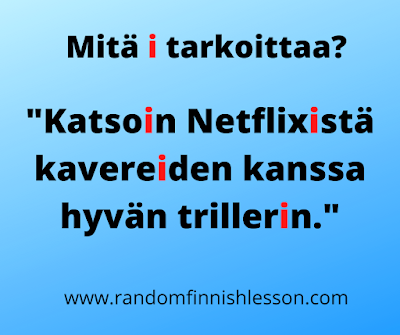
      When to put an i in the middle of (or after) a word in Finnish

      Finnish has eight vowels, but i it is definitely the most popular one when it comes to functioning as a marker, being used for making new words or joining Finnish endings to foreign names. Please leave a comment if I forgot something.


      1. Making loan words


      Loan words are often among the first words that students learn, because they are so easy to remember! Just ad an i at the end of the word in another language, and it might be a real word in Finnish. Sometimes we also change or double the consonant. (With verbs, the ending is -ata. I'll write about that later.)

      • posti - a post office, mail
      • kahvi - coffee
      • presidentti - a president 

      Loan words can also end with other vowels, but i is the most common one. You can read more in my post about the loan words. 


      2. A glue between a consonant and an ending when declinating names


      If a name ends with a vowel, we just add the ending: 

      • Hanna > Hannan kanssa - with Hanna

      If a name ends with a consonant, we add an i and then the ending: 

      • Max > Maxin kanssa - with Max
      • Charles > Charlesin kanssa - with Charles
      • Exception: Matias > Matiaksen kanssa - with Matias (also Topias, Markus and other names ending with as, us or os can behave like this.)


      Notice that if a word ends with a consonant but is pronounced with a vowel, we add an apostrophe, heittomerkki, and then the ending:


      3. Past tense marker


      We put an i or si between the verb stem and a personal ending to express that something happened in the past. 

      • sanon > sanoin  - I say > I said
      • pelaan > pelasin - I play > I played

      Sometimes vowels disappear or change, but there's always an i in the positive past tense.

      • olen > olin - I am > I was
      • maksan > maksoin - I pay > I paid

      You can read more in my post called Past tense in a nutshell.


      4. Plural marker


      The nominative plural marker is t:

      • talo > talot - a house > houses
      • laukku > laukut - a bag > bags
      • kissa > kissat - a cat > cats
      • nainen > naiset - a woman > women

      However, in all other cases, the marker is i. 

      • laukussa > laukuissa - in a bag > in bags
      • kadulla > kaduilla - on a street > on streets

      When i is placed between two vowels, it becomes j. This happens sometimes with plural genitive and with plural partitive. 

      • talo > taloja - a house > houses
      • kissan kanssa > kissojen kanssa - with a cat > with cats

      Sometimes the last vowel of the stem changes or disappears before the i: 

      • Minä tykkään kissasta. > Minä tykkään kissoista. - I like a/the cat. I like cats. 
      • Tykkään suomalaisesta oluesta ja suomalaisista. - I like Finnish beer and Finns.

      Read all my posts about the plural forms: 

      I know. The plural is quite tricky, so I should write more about it. 


      About the author of Random Finnish lesson: 


      My name is Hanna Männikkölahti. I am a professional Finnish teacher who gives private online lessons and simplifies books into easy Finnish. Please read more in www.linktr.ee/hannamannikkolahti and follow this blog, if you want to be the first one to know when I post something new. 

      Friday, October 23, 2020

      Online grammar and vocabulary exercises in Finnish

      Here's a little post about online exercises and tests. No matter how busy you are, you can always find 10 minutes for fun grammar and vocabulary exercises!

      • Taivuta.fi Declinating nouns and conjugating verbs in sentences. Also Finnish idioms!
      • Digijoujou-hanke: Superalkeet - Finnish for beginners
      • Yle: Finnish matriculation exams for Swedish speaking high school students who study Finnish: https://svenska.yle.fi/a/7-1448935 Two previous exams available, and also the correct answers. 


      Please leave a comment if you know some other useful links that I could add to this list. 

      Lue lisää - Read more: 


      Kiitos, kun luit! Jos pidit postauksesta, voit jakaa sen eteenpäin.
      Thanks for reading! If you enjoyed this post, feel free to share it. 
      – Hanna

      Tuesday, June 23, 2020

      Very common object sentences in Finnish

      Here's a list of sentences where the object is in the genitive case. All the sentences are positive. If they were negative, the object would be in partitive. 

      The first sentence is in standard Finnish, the second one in spoken Finnish. 

      1. Minä tiedän sen. Mä tiiän sen. - I know that.

      2. Luin hyvän kirjan. Mä luin hyvän kirjan. - I read a good book. (past tense)

      3. Ostin hänelle pienen lahjan. Mä ostin sille pienen lahjan. - I bought her a small present. 

      4. Voisitko antaa minulle omenan? Voisiksä antaa mulle omenan? - Could you give me an apple?

      5. Voisitko sanoa sen uudelleen? Voisiksä sä sanoo sen uudelleen? - Could you say it again?

      6. Miksi sinä ostit vain yhden sipulin? Miks sä ostit vaa yhen sipulin? - Why did you buy just one onion?

      7. Voitko ottaa minusta kuvan? Voiksä ottaa musta kuvan? - Can you take a picture of me?

      8. Minä haluan koiran! Mä haluun koiran! - I want to have a dog!

      9. Sinä tarvitset uuden puhelimen. Sä tarviit uuen puhelimen. - You need a new phone. 

      10. Minä löysin sen! Mä löysin sen! - I found it!

      11. Miksi sinä myit sen? Miks sä myit sen? - Why did you sell it?

      12. Lähetin hänelle viestin. Mä lähetin sille viestin. - I sent him a message. 

      13. Minä unohdin meidän tapaamisemme! Mä unohdin meidän tapaamisen! - I forgot our meeting!

      14. Muistitko maidon? Muistiksä maidon? - Did you remember the milk?

      15. Aiotko kutsua Liisan? Aioksä kutsuu Liisan? - Are you going to invite Liisa?

      16. Mistä sinä olet ostanut tämän? Mistä sä oot ostanut tän? - From where have you bought this?

      17. Ymmärsin melkein kaiken. Mä ymmärsin melkeen kaiken. - I understood almost everything.


      Lue lisää: 


      Kiitos, kun luit! Jos pidit postauksesta, voit jakaa sen eteenpäin.
      Thanks for reading! If you enjoyed this post, feel free to share it. 
      – Hanna