Showing posts with label How to say - Kuinka sanotaan. Show all posts

Monday, September 23, 2024

How to be unimpressed in Finnish

Don't get me wrong – I have a very positive mindset and appreciate even the smallest things in everyday life. However, sometimes I catch myself thinking a bit negatively about things that others are really excited about. 


Here's what I sometimes think:  


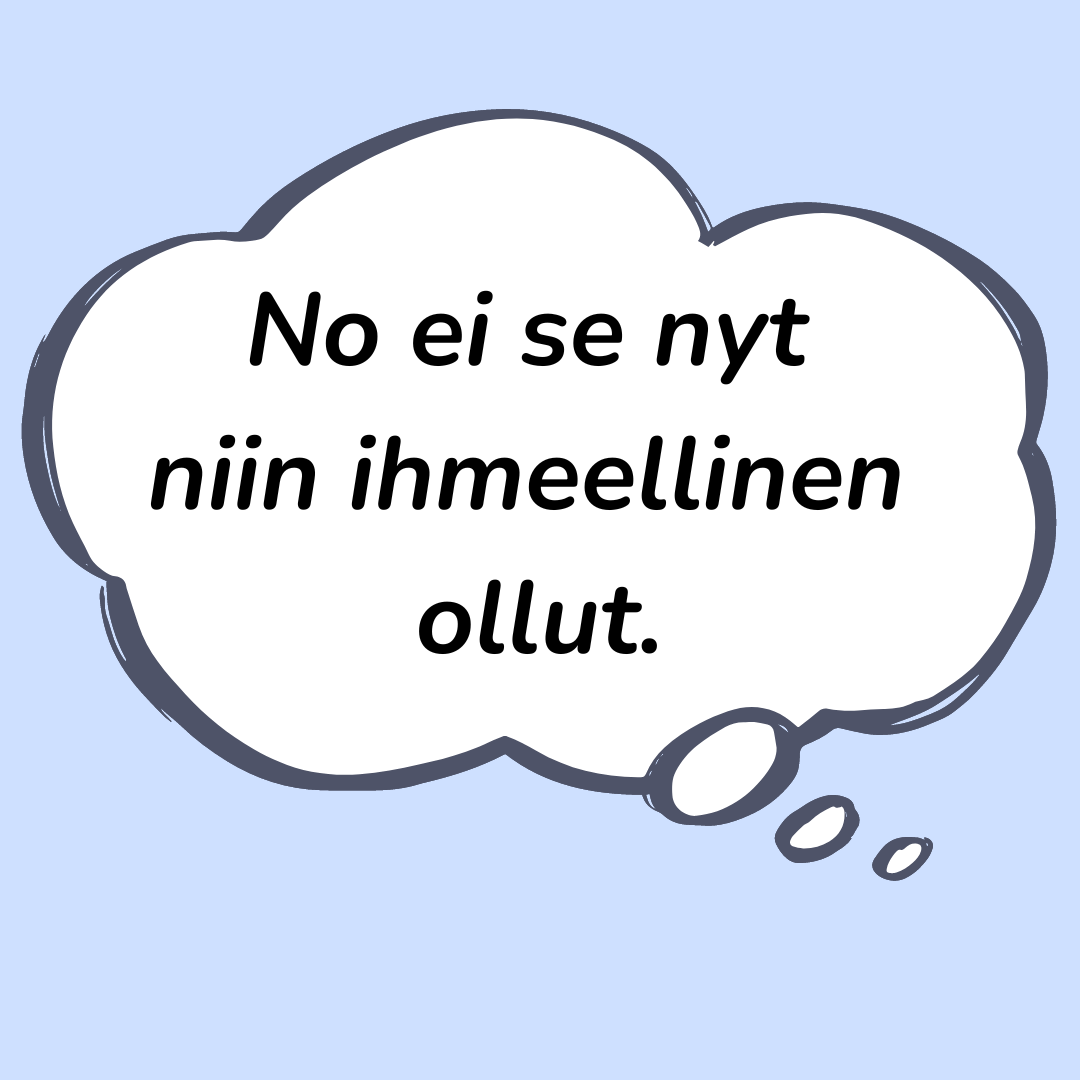
  • No ei se nyt niin ihmeellinen ollut. - Well, it wasn’t that special. (For example a single movie or a play) 
  • No ei se nyt niin ihmeellistä ollut. - Well, it wasn’t that extraordinary. (Use partitive when talking about the atmosphere or an experience. This has to do with describing things in Finnish.)
  • Se oli yhtä tyhjän kanssa. - It was as good as nothing. It was pointless. (tyhjä = empty)


Here are some more positive thoughts: 


  • Olisi se voinut olla huonompikin. - It could have been worse.
  • Ei siitä haittaakaan ollut. - It didn’t do any harm.
  • Olisin mä voinut tämän ajan huonomminkin käyttää.  - I could have spent this time in a worse way.


Lue lisää - Read more:


Kiitos, kun luit! Jos pidit postauksesta, voit jakaa sen eteenpäin.
Thanks for reading! If you enjoyed this post, feel free to share it. 
– Hanna

Wednesday, January 10, 2024

Talking about distance in Finnish


Pää can be translated as a head or an end. The inessive form päässä is often used in distance-related sentences:


  1. Kuinka kaukana se on?
  2. Kuinka pitkä (matka) sinne on?
  3. Se on aika lähellä.
  4. Se on tosi kaukana.
  5. Se on kivenheiton päässä. 
  6. Se on kilometrin päässä. 
  7. Se on puolen tunnin kävelymatkan päässä. 
  8. Se on puolentoista tunnin ajomatkan päässä.
  9. Se on kahden tunnin junamatkan päässä.

Pay attention to these examples: 


  • The word before päässä is in genitive. 
  • The weird number puolitoista is 1,5. 


Translations:


  1. Kuinka kaukana se on? - How far is it?
  2. Kuinka pitkä (matka) sinne on? - How long (of a distance) is it there?
  3. Se on aika lähellä. - It is quite close.
  4. Se on tosi kaukana. - It is very far. 
  5. Se on kivenheiton päässä. - It's a stone's throw away.
  6. Se on kilometrin päässä. - It's a kilometer away.
  7. Se on puolen tunnin kävelymatkan päässä. - It's within half an hour's walking distance.
  8. Se on puolentoista tunnin ajomatkan päässä. - It's within an hour and a half's driving distance.
  9. Se on kahden tunnin junamatkan päässä. -  It's within a two-hour train ride.

Kiitos, kun luit! Jos pidit postauksesta, voit jakaa sen eteenpäin.
Thanks for reading! If you enjoyed this post, feel free to share it. 
– Hanna

Friday, September 8, 2023

How to reschedule in Finnish

Do you sometimes have to cancel or reshedule a meeting? Here are a couple of phrases that you can use: 

Expressing that you are sorry 


  • Valitettavasti minun täytyy perua tapaamisemme. - Unfortunately, I have to cancel our meeting.
  • Olen pahoillani, mutta minun täytyy siirtää tapaamistamme. - I'm sorry, but I have to reschedule our meeting.
  • Pahoittelen, mutta en pääsekään tänään tapaamiseemme. - I apologize, but I can't make it to our meeting today.

In spoken finnish, the forms would be 'meidän tapaaminen', 'meidän tapaamista' and 'meidän tapaamiseen'.


Rescheduling


  • Voidaanko tavata samaan aikaan ensi viikolla? - Can we meet at the same time next week?
  • Onko sinulla vapaita aikoja myöhemmin tällä viikolla? - Do you have any available times later this week?
  • Mihin aikaan sinulle sopisi ensi viikolla? - What time would be suitable for you next week?
  • Sopiiko sinulle torstaina 14.9. klo 14.00? - Does Thursday, September 14th, at 2:00 PM work for you?


Depending on the situation and the person to whom you are writing, you might have to explain why. If you are my student, you don't have to. :)


Lue lisää:


Kiitos, kun luit! Jos pidit postauksesta, voit jakaa sen eteenpäin.
Thanks for reading! If you enjoyed this post, feel free to share it. 
Hanna

Saturday, September 3, 2022

How to say 'just in case' in Finnish

Just in case is either varalta or suosiolla, depending on the situation. 


Varalta = Just in case, in a neutral way.


  • Ostin varalta kaksi pulloa viiniä - I bought two bottles of wine, just in case. 
  • Ota varalta sateenvarjo mukaan. - Take an umbrella with you, just in in case (it rains). 
  • Otin kopioita siltä varalta, että joku unohti kirjansa kotiin. - I took copies in case someone forgot their book at home. 
  • Notice that in some dialects, people say varulta or varuilta.


'Suosiolla' has this idea that things could or will go badly. When you say 'suosiolla', you have kind of given up. 


  • Ostin suosiolla kaksi pulloa viiniä -  I bought two bottles of wine. Just in case, but I know that people will drink wine, and if I don't have enough, they'll be upset.
  • Otan suosiolla sateenvarjon mukaan. - I'll take an umbrella with me because I'm sure that it will rain. 
  • Siirretäänkö kokous suosiolla ensi viikolle? - Shall we postpone the meeting to the next week as it seems quite obvious that most people won't be able to come this week?


Lue lisää:


Kiitos, kun luit! Jos pidit postauksesta, voit jakaa sen eteenpäin.
Thanks for reading! If you enjoyed this post, feel free to share it. 
Hanna

Friday, August 19, 2022

Commenting on social media posts in Finnish

Here's something simple and nice that you can write when commenting on other people's social media pictures and posts. Translations after the picture. 


  1. Ihana kuva!
  2. Hieno video!
  3. Näyttää hauskalta!
  4. Olisinpa ollut tuolla!
  5. Hauskaa ja turvallista matkaa!
  6. Terveisiä tutuille!
  7. Kuulostaa hyvältä. 
  8. Hieno suunnitelma!
  9. Kiitos vinkistä! Pitääpä tutustua. 
  10. Kiitos seurasta! Toivottavasti nähdään taas pian!


Käännökset - Translations: 


  1. Ihana kuva! - Lovely picture!
  2. Hieno video! - Nice / Fancy / Great video!
  3. Näyttää hauskalta! - Looks fun!
  4. Olisinpa ollut tuolla! - I wish I had been there!
  5. Hauskaa ja turvallista matkaa! - Have a fun and safe trip!
  6. Terveisiä tutuille! - Say hi to the people that I know!
  7. Kuulostaa hyvältä. - Sounds good. 
  8. Hieno suunnitelma! - Great plan!
  9. Kiitos vinkistä! Pitääpä tutustua.  - Thanks for the tip. I'll have to take a look at that. 
  10. Kiitos seurasta! Toivottavasti nähdään taas pian. - Thanks for the company! I hope to see you soon again.

Lue lisää - Read more: 


If you want to say something more complicated that doesn't make much sense, check out this hilarious Jargonaattori.

About the author of Random Finnish Lesson: 

My name is Hanna Männikkölahti. I am a professional Finnish teacher who gives private online lessons and simplifies books into easy Finnish. Please read more in www.linktr.ee/hannamannikkolahti and follow this blog, if you want to be the first one to know when I post something new.  

Saturday, August 14, 2021

How to be stressed in Finnish

First vocabulary, then some sentences:

  • Stressi is stress.
  • Stressata is to stress.
  • Stressaava is stressful.
  • Stressaantua is to became stressed.
  • Stressaantunut is stressed.

  1. Mikä auttaa stressiin?
  2. Saanko lainata sun stressipalloa?
  3. Mikä sinua stressaa?
  4. Älä stressaa.
  5. Sinun ei kannata stressata tästä.
  6. Se oli todella stressaava tilanne. 
  7. Miksi sinä olet niin stressaantunut?
  8. Kuinka voin helpottaa äkillistä stressiä?


Here are the translations:

  1. Mikä auttaa stressiin? - What helps for stress?
  2. Saanko lainata sun stressipalloa? - Can I borrow your stress ball?
  3. Mikä sinua stressaa? - What's stressing you?
  4. Älä stressaa. - Don't stress.
  5. Sinun ei kannata stressata tästä. - It's not worth stressing about this.
  6. Se oli todella stressaava tilanne. - It was a really stressful situation.
  7. Miksi sinä olet niin stressaantunut? - Why are you so stressed?
  8. Kuinka voin helpottaa äkillistä stressiä?- How can I easen sudden stress?


Lue lisää: 


About the author of Random Finnish Lesson: 


My name is Hanna Männikkölahti. I am a professional Finnish teacher who gives private online lessons and simplifies books into easy Finnish. Please read more in www.linktr.ee/hannamannikkolahti and follow this blog, if you want to be the first one to know when I post something new.  

Monday, July 19, 2021

How to say 'enough' in Finnish

Tarpeeksi and riittävästi both mean enough. Here's something more about the words: 

Tarpeeksi


  • tarvita - to need something
  • tarve - a need
  • tarpeeksi - for one's need = enough
  • Onko sinulla tarpeeksi sukkia? - Do you have enough socks?

Riittävästi


  • riittää - to be enough
  • riittävä - adequate
  • riittävästi - adequately
  • Liikutko riittävästi? - Do you exercise enough? (liikkua = to move)
  • Onko sinulla riittävästi lämpimiä vaatteita mukana? - Do you have enoigh warm clothes with you?
  • Kiitos, tämä riittää. - Thank you. this is enough.
  • Mikään ei koskaan riitä sinulle! - Nothing is ever enough for you!

Lue lisää: 


Kiitos, kun luit! Jos pidit postauksesta, voit jakaa sen eteenpäin.
Thanks for reading! If you enjoyed this post, feel free to share it. 
Hanna


Wednesday, July 14, 2021

How to say "through" in Finnish

The English word through can be either läpi, kautta or myötä in Finnish. Here's how to use them: 


Läpi

  • Kävelin kotiin metsän läpi. - I walked home through the forest. 
  • Pääsin testistä läpi kolmannella kerralla! - I passed the exam on the third time!
  • Näkyykö tästä läpi? - Can one see through this?


Halki

  • Mies hiihti Suomen halki. - A man skied through Finland. (Halki seems to be almost the same as läpi. You could also say that Mies hiihti Suomen läpi.)  
  • Halki, poikki ja pinoon! - A Finnish expression related to wood chopping: Split in half, cut and put in a pile. People use this when they talk about how fast and effectively something was done. (Actually, the order should be poikki, halki ja pinoon.) 

Kautta

  • Kävelin kotiin metsän kautta. - I walked home through the forest. (And perhaps I stopped there for a while. Anyway, kautta is kind of stronger then läpi.)
  • Kävelin kotiin Alkon kautta. - I walked home through Alko (and I probably bought something).
  • Opin tämän asian kantapään kautta.  - I learned this through my mistakes (through my heel).


Myötä

  • Valokuvaaja alkoi kuvata koiria koronapandemian myötä. - A photographer started to take pictures of dogs throughout / during the pandemic. (Voit lukea artikkelin täällä.)
  • Olen alkanut ymmärtää suomalaisia paremmin tämän tv-sarjan myötä.  - I have started to understand Finns better because of this tv series.


Thanks for reading! If you enjoyed this post, feel free to share it. 
Kiitos, kun luit! Jos pidit postauksesta, voit jakaa sen eteenpäin.
– Hanna 


Tuesday, March 30, 2021

How to be exhausted and burdened in Finnish


  • Väsyä is to get tired.
  • Väsynyt is tired.
  • Väsyttää is to make someone tired


Here are some useful words when you are more than tired:


  1. uuvuttaa - to exhaust
  2. uuvuttava - exhausting
  3. uupunut - exhausted
  4. uupumus - exhaustion
  5. työuupumus - burnout
  6. kuormittaa - to burden (kuorma = a load, a burden)
  7. kuormittava - burdening
  8. kuormittunut - burdened
  9. ylikuormittunut - overladen


Here's how to use them in a sentence: 


  • Olen uupunut tähän kaikkeen. - I'm exhausted with all this.  
  • Viime viikko oli todella uuvuttava. - Last week was really exhausting.
  • Älä uuvuta itseäsi. - Don't exhaust yourself. 
  • Hän kärsii työuupumuksesta. - He is suffering from burnout.
  • Hänellä on kuormittava työ. - She has a burdening job. 
  • En haluaisi kuormittaa häntä. - I wouldn't want to burden her. 
  • Kaikki ylimääräiset kokoukset kuormittavat minua. - All the extra meetings are burdening me. 
  • Aivoni ovat ylikuormittuneet kaikista näistä kysymyksistä. - My brain is overladen with all these questions.

Lue lisää: 


Kiitos, kun luit! Jos pidit postauksesta, voit jakaa sen eteenpäin.
Thanks for reading! If you enjoyed this post, feel free to share it. 
– Hanna

www.privatefinnishlessons.com  

Sunday, May 31, 2020

How to swear in Finnish

I don't want to encourage anyone to swear in any language, but here's a small post about the grammar of swearing in Finnish. Feel free to try out the structures with any swear word you like. Sometimes it works, sometimes not. 

Notice that the translations on italics are word-for-word translations and I know they sound a bit strange. :)


Things to say when you can't say perkele.


1. The nominative is often used with interjecitons voi, ei and no. Also with the command haista, which means smell.


  • Voi helvetti! - Oh hell!
  • Voi perse. - Oh ass.
  • Ei helvetti! - Hell no!
  • No perkele! - Well, damn it!
  • Haista paska! - Smell shit!

2. A swear word in genitive makes the following adjective or another swear word stronger. You can also add a swear word in genitive after joka, every.


  • Se oli helvetin vaikea koe. - It was a damned difficult exam.
  • Voi helvetin helvetin helvetti! - Oh helling hell's hell!
  • Voi helvetin perse. - Oh hell's ass. 
  • Mun naapuri käy suihkussa joka helvetin yö. - My neighbour takes a shower every f*cking night. 


3. A swear word in partitive is often used with a question word mitä, an interrogative particle ko, or with a postposition päin, towards.


  • Mitä helvettä täällä tapahtuu? - What the hell is happening here?
  • Vittuako se sulle kuuluu? - How's that any of your f*cking business?
  • Vittuuks sä siitä mitään tiedät? - How the f*ck would you know anything about it? 
  • Kaikki meni päin helvettiä. - Everything went towards hell. 


4. When things go wrong, you can also use translative plural or allative, depending on the swear word. (As you can see, I translated the expressions word-for-word.)


  • Vituiksi meni! - It turned into multiple vaginas. (You can also say Vituiks män and impress the Eastern dialect speakers!)
  • Se meni ihan perseelleen. - It went totally onto one's ass. 

5. Use the swear word in inessive after totta to express that something is very true. You can always put a swear word in inessive after missä.


  • Totta helvetissä! - True in hell! 
  • Ei helvetissä! - No way in hell!
  • Missä helvetissä sinä olet ollut? - Where the hell have you been?

6. The elative is often used when asking where something came from, but it's also used in other expressions.


  • Mistä helvetistä tuo tuli? - Where the hell did that come from?
  • Helvetistäkö minä tiedän? - How the hell do I know? (Is it from the hell that I know?)

7. Use the illative if you want to wish another person to go (or sink) somewhere. 


  • Painu helvettiin! - Go to hell!

Learn to swear with Sari in Juurihoito!. :)  


Read and watch more:


Kiitos, kun luit! Jos pidit postauksesta, voit jakaa sen eteenpäin.
Thanks for reading! If you enjoyed this post, feel free to share it. 
– Hanna

Sunday, May 3, 2020

How to say 'without' in Finnish

Here's a post about different ways to express withoutness in Finnish. It can be done with a preposition ilman, a derivational ending -ton, or an adessive ending -tta added to a noun stem or to a MA infinitive of a verb.


1. Ilman is the prepositon without. It is used with a partitive.


  • En voi elää ilman sinua! - I can't live without you!
  • Älä mene ulos ilman takkia.  -  Don't go outside without a jacket. 

2. To make an adjective, add the derivational suffix -ton or -tön to a noun stem or to the agent participle stem.


  • sokeri > sokeriton - sugar > sugar-free
  • työ > työtön - job, work > unemployed
  • uskoa > uskomaton - to believe > unbelievable
  • kirjoittaa > kirjoittamaton - to write > unwritten

Notice how the -ton  changes to -ttoma- when you add other case endings than partitive:

  • Onko tähän rasvattomaan maitoon lisätty D-vitamiinia? - Have they added  vitamin D into this fat free milk?
  • Sokerittomissa juomissa on muita makeutusaineta. - There are other sweeteners in sugar-free drinks.
  • Asiattomilta pääsy kielletty. - No trespassing. Stay out, if you don't have a good reason to be here. (Asia is a thing. Asiaton is a person who has no reason to be somewhere.) 
  • Onko sinulla paljon tekemättömiä töitä? - Do you have a lot of undone tasks?
  • Tämä on uskomatonta! - This is unbelievable!

3. To make an adverb, add the abessive ending -tta or -ttä to a noun stem.


  • Älä mene ulos takitta.  - Don't go out without a jacket. (However, it's more common to say ilman takkia.)
  • Kokous sujui ongelmitta. - The meeting went along without problems. 

4. With verbs, add -matta or -mättä to the strong verb stem. 


  • En voinut olla ostamatta tätä laukkua! - I couldn't be without buying this bag!
  • En voinut olla kertomatta tätä sinulle. - I couldn't be without telling this to you.
  • Hän lähti sanomatta sanaakaan. - He left without saying a word. 
  • Ole syömättä kaksitoista tuntia ennen leikkausta. - Be without eating for twelve hours before the operation. 

Read more and listen to songs with ilman:


Kiitos, kun luit! Jos pidit postauksesta, voit jakaa sen eteenpäin.
Thanks for reading! If you enjoyed this post, feel free to share it. 
– Hanna

Wednesday, June 12, 2019

How to say 'before' in Finnish

Ennen


Before is ennen.


  • Muista pestä kädet ennen päivällistä. - Remember to was (your) hands before dinner. 
  • Minä olin tässä ennen sinua. - I was here before you.
  • Minä olin tässä sinua ennen. - I was here before you.
  • Mä soitan sulle ennen neljää. - I'll call you before four o'clock.

Ennen can also express that somebody or something used to do or be something.


  • Se asui ennen Helsingissä. - He used to live in Helsinki.
  • Tässä oli ennen kahvila. - There used to be a café here. 
  • Tämä oli ennen keltainen. - This used to be yellow.

Ennen kuin


Use ennen kuin before a verb.


  • Soita minulle ennen kuin lähdet. - Call me before you leave.
  • Etkö sinä käy suihkussa ennen kuin menet nukkumaan? - Don't you take a shower before you go to sleep? 

Notice that in spoken Finnish, ennen kuin is often ennen ku.


Lue lisää: 


Kiitos, kun luit! Jos pidit postauksesta, voit jakaa sen eteenpäin.
Thanks for reading! If you enjoyed this post, feel free to share it. 
– Hanna

Wednesday, April 24, 2019

How to fart in Finnish

Pieru is a fart.

Do you know the difference between these verbs? They all have something to do with farting. 
  1. pieraista
  2. piereskellä
  3. pierettää
  4. pierrä

These sentences might help you:

  1. Kuka pieraisi?
  2. Mun naapuri piereskelee parvekkeella. 
  3. Hernekeitto pierettää. 
  4. Häntä pieretti koko taksimatkan.
  5. Pierevätkö kaikki eläimet?

https://www.hs.fi/viivijawagner/


Fart-related verbs in Finnish and in English


  1. pieraista - to fart once
  2. piereskellä - to fart continuously
  3. pierettää - to make you fart, to feel like farting
  4. pierrä - to fart in general

Fart-related sentences in Finnish and in English


  1. Kuka pieraisi? - Who farted?
  2. Mun naapuri piereskelee parvekkeella. - My neighbour farts on the balcony.  
  3. Hernekeitto pierettää. - Pea soup makes you fart. 
  4. Häntä pieretti koko taksimatkan.  - He felt like farting during the whole taxi trip. 
  5. Pierevätkö kaikki eläimet? - Do all animals fart?

If you accidentally fart, you can say Anteeksi, minulta pääsi pieru which means I'm sorry, a fart got out of / away from me.


If you liked this post, you might also like these ones:


Kiitos, kun luit! Jos pidit postauksesta, voit jakaa sen eteenpäin.
Thanks for reading! If you enjoyed this post, feel free to share it. 
Hanna

Tuesday, April 23, 2019

How to sleep in Finnish

Here are three small dialogues about sleeping. Leave a comment if you need help translating them or if Google Translate suggests something strange.

- Nukuitko hyvin?
- En. En saanut unta ja nukahdin vasta kolmelta. 
- Toivottavasti sä et nukahtele töissä. 

- Voitko laittaa lapset nukkumaan? Mä en millään jaksaisi nukuttaa niitä. 
- Nukuttaminen kestää niin kauan!
- No niinpä. Voi kun ne nukkuisivat jo.

- Mä menen nyt nukkumaan. Öitä.  
- Mua ei nukuta vielä. Hyvää yötä!

Verbs related to sleeping


  1. nukahdella
  2. nukahtaa
  3. nukkua
  4. nukuttaa
  5. laittaa nukkumaan
  6. mennä nukkumaan
  7. saada unta

Translations


  1. nukahdella - to repeatedly fall asleep (Read more about frequentative verbs.)
  2. nukahtaa - to fall asleep (Yes, the ahta-infix makes it a sudden thing. How cool is that!)
  3. nukkua - to sleep
  4. nukuttaa - to make someone sleep or to feel like sleeping
  5. laittaa nukkumaan - to put someone sleep
  6. mennä nukkumaan - to go to sleep
  7. saada unta - to manage to get some sleep 

Related posts: 


Kiitos, kun luit! Jos pidit postauksesta, voit jakaa sen eteenpäin.
Thanks for reading! If you enjoyed this post, feel free to share it. 
– Hanna

Tuesday, March 12, 2019

How to blame things in Finnish

Did you know that Finnish has a lovely way to blame innocent objects for one's own mistakes? Here's how it's done:


Use jäädä instead of jättää:


  • Blame yourself: Mä jätin mun pyyhkeen uimahalliin. - I left my towel in the swimming hall. 
  • Blame the object: Mun pyyhe jäi uimahalliin. - My towel forgot itself in the swimming hall. 
  • Blame yourself: Mä jätin tämän tekstin lukematta. - I left this text unread. 
  • Blame the object: Tämä teksti jäi lukematta. - This text remained unread. 


Use unohtua instead of unohtaa:


  • Blame yourself: Mä unohdin mun lompakon kotiin.  - I forgot my wallet at home.
  • Blame the object: Mun lompakko unohtui kotiin. - My wallet forgot itself at home. 

Use kadota instead of kadottaa:


  • Blame yourself: Minä kadotin avaimen. - I lost the key.
  • Blame the object: Avain katosi. - The key disappeared. 


Related posts:


Kiitos, kun luit! Jos pidit postauksesta, voit jakaa sen eteenpäin.
Thanks for reading! If you enjoyed this post, feel free to share it. 
– Hanna

Wednesday, September 5, 2018

How to get used to things in Finnish


Tottua is one of those verbs that require the illative case.

  • Täällä on kuuma. - Sä totut siihen pian. - It's hot in here. - You'll get used to it soon. 
  • Mä olen jo tottunut kylmään ja pimään. - I'm already used to cold and dark.
  • Mä en ikinä totu tähän! - I'll never get used to this!

Related posts and links: 


Kiitos, kun luit! Jos pidit postauksesta, voit jakaa sen eteenpäin.
Thanks for reading! If you enjoyed this post, feel free to share it. 
Hanna

Thursday, July 5, 2018

How to say the "ing" form in Finnish

Sometimes people ask me how to say the English -ing form in Finnish. I came up with these examples of reading:

1. Indicative verb form with a partitive object


  • Luen hyvää kirjaa. - I'm reading a good book.

2. MA infinitive (inessive, elative, adessive or abessive)


  • Olin kirjastossa lukemassa. - I was in the library reading. 
  • Milloin tulet lukemasta? - When will you come from reading? 
  • Voit oppia lisää lukemalla. - You can learn more by reading.
  • En voi olla lukematta tätä kirjaa! - I can't be without reading this book!


4. VA participle


  • Kuka tuo kirjaa lukeva mies on? - Who is that man reading a book?
  • Näin jonkun lukevan tuota kirjaa eilen. - I saw someone reading that book yesterday.  You can also say Näin, että joku luki tuota kirjaa eilen. (Here's the referative construction for grammar lovers!)

5. E-infinitive instructive


  • Lapsi juoksi itkien kotiin. - A child ran home crying.

6. Essive


  • Istuin väsyneenä bussissa. - I sat on the bus feeling tired. 


Kiitos, kun luit! Jos pidit postauksesta, voit jakaa sen eteenpäin.
Thanks for reading! If you enjoyed this post, feel free to share it. 
– Hanna

Saturday, March 17, 2018

How to say 'until' in Finnish


Asti and saakka both mean until a certain time or a place.


  • Olen töissä viiteen asti. - I'll be at work until five. 
  • Juoksin kotiin saakka. - I run (all the way to) home. 

Notice that these words can also be used with 'from':

  • Olen ollut hereillä viidestä asti - I've been awake since five o'clock.
  • Kävelitkö tänne kotoa saakka? - Did you walk here all the way from home? 


Kunnes is until something happens.


  • Etsin, kunnes löydän sen. - I'll search until I find it.
  • Luin, kunnes nukahdin.  - I read until I fell asleep.
  • Kalle joi, kunnes sammui. - Kalle drank until he passed out.


Lue lisää:


About the author of Random Finnish Lesson: 


My name is Hanna Männikkölahti. I am a professional Finnish teacher who gives private online lessons and simplifies books into easy Finnish. Please read more in www.linktr.ee/hannamannikkolahti and follow this blog, if you want to be the first one to know when I post something new. 


Thursday, January 11, 2018

How to ask for a new parking garage ticket in Finnish

Here's a dialogue that I had yesterday after realizing that I had lost my parking garage ticket. Just in case you are ever in the same situation and you have to press the Asiakaspalvelu button on the machine, this is what I said:

Minä:
Hei, mä olen hukannut mun parkkilipukkeen. Mä parkkeerasin tänne puoli kymmeneltä, niin voinko mä saada uuden lipukkeen?

Asiakaspalvelija:
Oletko ihan varma, että se ei jäänyt autoon?

Minä:
Ei jäänyt. Mä muistan, että mä laitoin sen mun taskuun, mutta se on varmaan pudonnut maahan.

Asiakaspalvelija:
No haluaisitko sä käydä etsimässä sitä?

Minä:
No en, kun se voi olla ihan missä vaan. Kuinka paljon se uusi lipuke maksaa?

Asiakaspalvelija:
Se on koko päivän parkkimaksu eli viistoista euroa.

Minä:
Okei. Mä odotin jotain paljon enemmän.

Asiakaspalvelija:
Sä voit laittaa sun kortin sisään niin mä laitan sulle uuden lipukkeen tulemaan.

Minä:
Selvä. Kiitos. (Työnnän pankkikortin automaattiin.)

Asiakaspalvelija:
Noin. Mä annoin sulle vitosen alennusta.

Minä:
Ai. Kiitos. Moi moi.


To learn about parking halls in your city, just google pysäköintitalot and the name of the city.

Pysäköintilipuke = parkkilippu = parkkilappu 

...........................

About the author of this blog:  


My name is Hanna Männikkölahti, and I am a native Finn who gives private lessons via Skype and simplifies books into easy Finnish. Please leave a comment, if you have something to ask about Finnish or novels in easy Finnish.