Saturday, October 14, 2017

What to watch in Yle Areena

It's been a while since I recommended tv shows to watch in Finnish.

Here are three Yle Areena shows that are also available abroad:


If you are watching Yle Areena in Finland, you have to check out Sohvaperunat. Finnish people watching tv together with their friends and family. What could be better entertainment? :)

Sohvaperunat. Sohva = a sofa / a couch, Peruna = a potato

p.s. You can also order my blog to your email. Type your email to where it says "Read my posts in your email"  in the right hand banner.

Wednesday, October 11, 2017

Choosing the perfect easy Finnish book

Would you like to read a book in easy Finnish, but you don't know which book would be good for you right now? Here's a handy flowchart that I just created:


You can take a look at the sample pages in Selkokeskus website. Booky.fi is another good online bookstore, and they also ship abroad.

Related posts:


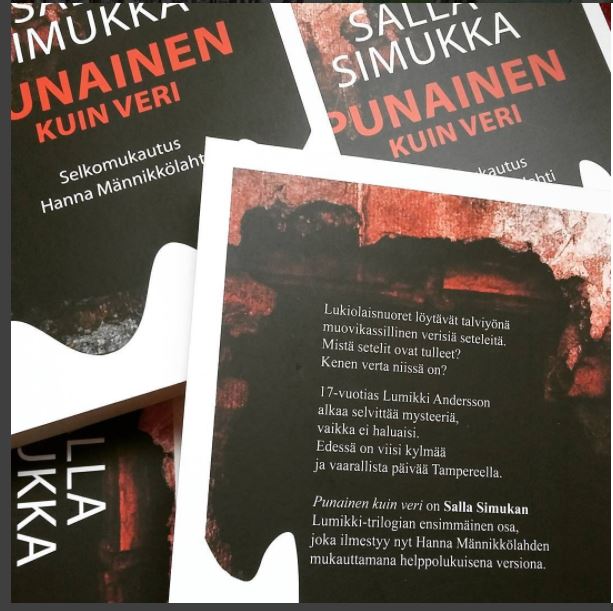
Selkokirjoja. Books in easy Finnish.


Thursday, September 28, 2017

Finnish words with a lot of ö's

It's time for a fun list!

Do you know the meaning of this ö-words?

  1. dödö
  2. hölmö
  3. Höpö höpö!
  4. kökkö
  5. löllö
  6. mömmö
  7. mörkö
  8. nössö
  9. pöllö
  10. pönttö
  11. pöpö
  12. söpö
  13. tönö

Here are the translations:

  1. dödö - a colloquial word for deodorantti
  2. hölmö - a fool
  3. Höpö höpö! - Just kidding!
  4. kökkö - bad or tasteless as in kökköenglanti or kökkö elokuva
  5. löllö - wobbly as in löllö käsivarsi, a wobbly arm
  6. mömmö - goo as in Mitä tämä vihreä mömmö on? What's this green goo?
  7. mörkö - a boogeyman, or this scary Moomin character
  8. nössö - a wimp, a sissy
  9. pöllö - an owl
  10. pönttö - a toilet bowl, a large can, or a dumb person
  11. pöpö - a children's word for bakteeri
  12. söpö - cute
  13. tönö - a shack
Söpö pöllö.

Here are some other lists on this blog:


About the author of Random Finnish Lesson: 


My name is Hanna Männikkölahti. I am a professional Finnish teacher who gives private online lessons and simplifies books into easy Finnish. Please read more in www.linktr.ee/hannamannikkolahti and follow this blog, if you want to be the first one to know when I post something new.  

Tuesday, September 26, 2017

How to use the Finnish plural demonstrative prononuns 'nämä', 'nuo' and 'ne'

Who doesn't love Finnish demonstrative pronouns? I already have posts about the singular demonstrative pronouns:


This post is about the plural demonstrative pronouns nämä, nuo and ne - these, those and they.

Here's a little table with nämä, nuo and ne in nominative, partitive, genitive and local cases. I've noticed that very often students use nuo when they should use ne. 


nämä (these)
nuo (those)
ne (them)
näitä
noita
niitä
näiden
noiden
niiden
näissä
noissa
niissä
näistä
noista
niistä
näihin
noihin
niihin
näillä
noilla
niillä
näiltä
noilta
niiltä
näille
noille
niille


Nämä - These


  • Keneltä sä sait nämä? - From whom did you get these?
  • Mitä sä teet näillä? - What do you do with these?
  • Mitä sä laitat näihin? - What will you put into these?

Nuo - Those (that you can point at)


  • Mitä noissa laatikoissa on? - What's in those boxes?
  • Mä en kestä noita! - I cannot stand those guys.
  • Mä käyn sanomassa noille, että me tullaan pian. - I'm going to go and tell those guys that we're coming soon.

Ne - They, the, them or those 

(something that you cannot see right now, or that are close to the person you are talking to) In colloquial Finnish, we often say ne instead of he.

  • Mä juttelin niiden kanssa eilen. - I spoke with them yesterday. 
  • Kysytään niiltä! - Let's ask them!
  • Mitä sä teet niille vanhoille sukille? - What will you do to those/the old socks?


Related posts:


Kiitos, kun luit! Jos pidit postauksesta, voit jakaa sen eteenpäin.
Thanks for reading! If you enjoyed this post, feel free to share it. 
– Hanna

Saturday, September 23, 2017

Talking about different groups in Finnish

Do you know the difference between these words that mean some kind of a group in Finnish?


  1. jengi: Kiva, kun jengi diggaa!
  2. joukkue: Meidän joukkue oli paras!
  3. porukka: Mikä porukka te oikein olette?
  4. ryhmä: Meidän ryhmä voi aloittaa.
  5. tiimi: Kuinka monta koodaajaa teidän tiimissä on?
  6. luokka: Meidän luokka on tosi kiva.


Here are the definitions:


  1. jengi - a gang. Jengi can be a criminal gang, but it can also be a group of friends or fans.
  2. joukkue  - a (sports) team
  3. porukka - a group of people, often used in spoken language. In some dialect, porukat means parents.
  4. ryhmä - a group, can be people or things.
  5. tiimi - a team, often at work. A loan word from the English team.
  6. luokka - a group of school students, but also a class room.


Here are the translations:


  1. Kiva, kun jengi diggaa! - It's nice that people like (me)!
  2. Meidän joukkue oli paras! - Our team was the best!
  3. Mikä porukka te oikein olette? - What (kind of a) group are you?
  4. Meidän ryhmä voi aloittaa. - Our group can start.
  5. Kuinka monta koodaajaa teidän tiimissä on? - How many coders do you have in your team?


Ryhmä Hau. Hau is what a dog says in Finnish.


About the author of Random Finnish Lesson: 


My name is Hanna Männikkölahti. I am a professional Finnish teacher who gives private online lessons and simplifies books into easy Finnish. Follow this blog, if you want to be the first one to know when I post something new.  If you want to subscribe to my newsletter, you can do it here.


Friday, September 22, 2017

Keskitason kirjoituskurssi - An intermediate writing course

Oletko menossa keskitason Yki-testiin tammikuun 27. päivä?
Haluaisitko saada palautetta teksteistäsi ja oppia myös toisten opiskelijoiden teksteistä? Osallistu kirjoittamisen minikurssille! 

Kurssin aikana opiskelijat kirjoittavat viisi tekstiä ja saavat niistä palautetta yhteisen Google-dokumentin kautta. Kirjoitettavia tekstejä on yksi viikossa, ja kaikki näkevät kaikkien tekstit ja opettajan kommentit. Emme tapaa toisiamme kurssin aikana, mutta voimme keskustella kirjoittamalla Google Docsissa. Kurssin hinta on 50 €. 

Kurssin aikataulu: 

  • Ensimmäisen tekstin palautus 12.11. mennessä
  • Toisen tekstin palautus 19.11. mennessä
  • Kolmannen tekstin palautus 26.11. mennessä
  • Neljännen tekstin palautus 3.12. mennessä
  • Viidennen tekstin palautus 10.12. mennessä

Lähetä sähköpostia osoitteeseen hanna.mannikkolahti@gmail.com, jos haluat tilata kurssimateriaalin ja ilmoittautua kurssille.

Suosittelen lämpimästi Harjoitus tekee mestarin 4 -kirjaa. Kirjan lopussa on hyviä kirjoittamisen tehtäviä ja mallitekstejä. 

p.s. Jos haluat tehdä kirjoittamisen kurssin omassa tahdissasi etkä halua näyttää tekstejäsi muille, se on myös mahdollista. Kurssin voi aloittaa milloin tahansa.

Thursday, September 21, 2017

Booking a library book online in Finnish

Onko sinulla kirjastokortti? - Do you have a library card?

If not, go to the nearest library and get one! For online booking, you probably also need a code number that you can get from the librarians.

Varata is to book or to reserve, and varaa is the imperative form of the verb. Once you have found the book that you want, click varaa. Depending on the online booking system, you might have to click saatavuus (availability) before you can see the varaa button.


After that, choose the library from where you want to pick up the book. (I just had to check the English translation of noutopaikka, and according to my library's website, it's a pick-up branch.) Remember to click tallenna varaus, which means save the reservation. 


Reserving books and dvds is free, but if you don't pick up what you have reserved, you have to pay 2 euros, at least in Central Finland. You'll get a text message when the book is available in your chosen library, and you can go and pick it up from the bookshelf where they collect all the reserved items. The bookshelf is also a fun place to see which books and dvd's people want to borrow! 


Related posts: 


Selkokirjoja. Books in easy Finnish.
Notice that the easy Finnish books are often placed in three different sections in the librabry: children's books, young adult books and adult books. Ask the librarians for help!

. . . . . . . . . . . . . . . . . . . . .

About the author of this blog:

My name is Hanna Männikkölahti, and I am a native Finn who gives private lessons via Skype and simplifies books into easy Finnish. Please leave a comment, if you have something to ask about Finnish or novels in easy Finnish. 


Lue lisää selkokirjoista: https://privatefinnishlessons.com/books/

Monday, September 18, 2017

When things are not quite right in Finnish

Here's a list of expressions that you can use when things (or quite often clothes) are not the correct way. First, see if you have heard these ones before:

  1. nurinkurin
  2. päinvastoin 
  3. sikin sokin
  4. takaperin
  5. toisin päin 
  6. väärin päin 
  7. ylösalaisin 

Here are the translations in sentences. Notice that the correct spelling of these expressions is tricky for native Finns as well. Sometimes both forms are correct.

  1. Sun paita on nurinkurin.  - Your shirt is inside out.
  2. Mä tarkoitin päinvastoin. - I meant the the opposite way.
  3. Sun huone on ihan sikin sokin! - Your room is a mess! (You can also say mullin mallin, hyrskyn myrskyn or hujan hajan!)
  4. Sun paita on takaperin. - Your shirt is backwards.
  5. Laita ne kengät toisin päin - Put the shoes the other way round.
  6. Sä kirjoitit tämän d-kirjaimen väärin päin. - You wrote this letter d the wrong way.
  7. Käännä se kakku ylösalaisin. - Turn the cake upside down.

Related post:


Kirjoja sikin sokin!


Thanks for reading! If you enjoyed this post, feel free to share it. 
Kiitos, kun luit! Jos pidit postauksesta, voit jakaa sen eteenpäin.
– Hanna

Monday, August 21, 2017

How to say "by" in Finnish

Yes, how to say by is a tough question. Sometimes it seems that you can just use by in the middle of a Finnish expression:


I would say that you have four ways to avoid the horrible use of by in the middle of a Finnish text:

1. Use a genitive:


  • Suomen käsityömuseon järjestämä kansallispukunäytös - A national costume show organized by Craft Museum of Finland

3. Use a whole sentence: 


4. Use a colon or parenthesis:


I know that something by someone is a quite popular structure when it comes to Finnish blogs and small business and event names. I wonder how many years it will take and we'll have Uudenvuoden puhe by tasavallan presidentti?

Similar posts:


p.s. If you like my posts, it would be really really nice if you did at least some of these things: 


 Minä olen kirjoittanut nämä selkokirjat! www.privatefinnishlessons.com/books
www.privatefinnishlessons.com/books
.
...........................

About the author of this blog:  

My name is Hanna Männikkölahti, and I am a native Finn who gives private lessons via Skype and simplifies books into easy Finnish. Please leave a comment, if you have something to ask about Finnish. Click here to see all my courses.


Friday, August 18, 2017

New podcasts in Mixcloud

Some of you might know that I have a Mixcloud account. I basically just interview people in easy Finnish and try to make them speak a bit more calmly and with simple structures and vocabulary. The latest interviews are with my friend and with my mother. I Hope you'll enjoy listening to us! :)

Click here to listen to Tulkki ja suomen kielen opettaja - An interpreter and a Finnish teacher.

Click here to listen to Käräjätuomari - A judge of district court.

p.s. It would be super nice if you commented something after listening to the podcast! I'm actually trying to persuade real radio people to make a real podcast with me, so it would be useful to have feedback from actual listeners.:)