Monday, September 15, 2014

How to talk about being busy and urgent in Finnish

Notice the difference in use between these three words that all mean busy, hurry, or some sort of rush.

Kiire - hurry (a noun)


  • Minulla on kiire. - I'm busy.
  • Onko sulla kiire? - Are you busy?
  • Miksi sulla on aina kiire? - Why are you always in a hurry?

Kiireinen - busy (an adjective)


  • Hän on todella kiireinen. - He is really busy.
  • Ensi viikko on todella kiireinen, mutta sitten helpottaa. - Next week will be really hectic, but then it will be easier.

Kiireellinen - urgent (an adjective, not used with people.)


Älä kiirehdi. - Don't rush.


Kiitos, kun luit! Jos pidit postauksesta, voit jakaa sen eteenpäin.
Thanks for reading! If you enjoyed this post, feel free to share it. 
– Hanna


Thursday, September 11, 2014

Working in Finland

Here's a new website about working in Finland. The information is in 13 languages, which is pretty cool. To work in Finnish is not työdä, although many students wish it was so. Actually, it's not a word at all, at least not yet. Here's a post about olla töissä. 


Hauskaa työpäivää! - Have a nice day at work!

Wednesday, September 10, 2014

The Finnish enclitic particle pa (or pä)

I just found this post in my draft folder. Olipa kiva yllätys! - What a nice surprise!

Translating pa or pä is kind of tricky. I hope that these examples help you to understand how it's used and what it expresses. Just like kin, you can use this enclitic participle only once in a sentence. Pa or pä is usually added to the first word of the sentence.

If you have Leila White's Grammar book of Finnish, you'll find more examples of this and other enclitic particles in the end of the book.   

A surprise or an emphasis


  • Onpa komeat viikset! - Such a handsome mustache!
  • Lauloitpa sinä hyvin! - Oh how well you sung!
  • Onpa teillä kiva koti. - Such a nice home you have.
  • Olipa kiva päivä! - What a nice day it was!
  • Tulipa siitä hieno kakku! - Wow, that cake turned out fancy!
  • Minäpä soitan nyt isoäidille. - Well, I'm going to call grandma now. 
  • Mepä syötiin jo! - We ate already!
  • Mikkopa lähtee vaihto-oppilaaksi. - Well, Mikko is going to be an exchange student.

A mild command (Notice how the pronunciation of p doubles in the singular imperative forms.)


  • Syöpä nyt reippaasti! - Why don't you eat cheerily now! [syöppä]
  • Puepa sukat jalkaan! - Why don't you get the socks on! [pueppa]
  • Istupa tähän joulupukin syliin. - Why don't you sit here on the Santa Claus' lap. [istuppa]
  • Tulkaapa pojat tänne! - Why don't you boys come here! 
  • Kertokaapa, mistä te saitte nuo. - Why don't you tell where you got those.

Disagreeing, child-like arguing


  • (Minä istun tässä.) Minäpä! - (I'll sit here.) No, I will!
  • (Tämä oli minulla ensin.) Eipä ollut! - (I had this first.) No you didn't!
  • (Miksi sinä et siivonnut?)  Siivosinpa!! - (Why didn't you clean up?) Yes I did!

A wish


  • Olisipa jo huominen! - I wish it was tomorrow already!
  • Sataisipa jo lunta! - I wish it would snow already!


Mainos: Tervetuloa ääntämisen työpajaan torstaina 15. syyskuuta!


About the author of Random Finnish Lesson: 


My name is Hanna Männikkölahti. I am a professional Finnish teacher who gives private online lessons and simplifies books into easy Finnish. Please read more in www.linktr.ee/hannamannikkolahti and follow this blog, if you want to be the first one to know when I post something new.  

Sunday, September 7, 2014

My first Quizlet flash cards

I created a set of flash cards in Quizlet for my beginner's students, and I thought I might share them here, too. I am not the person reading the cards aloud, in case you wonder. :)

Update: Here's a link to all the Quizlet sets that I've created. I've also tried Memrise, but I like Quizlet better because of the games.

Saturday, September 6, 2014

When to say 'mikä' and 'mitä' in Finnish

These two question words are often mixed. They both mean what. 


This is a bit confusing for me too, so I'll keep updating this post as I learn more. :)

Mikä is used when you assume that the answer is a one countable thing.


  • Mikä tämä on? Lautanen. - What is this? A plate. 
  • Mikä sun puhelinnumero on? - What's your phone number?
  • Mikä sun osoite on? - What's your address?
  • Mikä sun kysymys oli? - What was your question?


Mikä can also be used with other verbs, if it refers to the subject of the sentence: 


  • Mikä bussi menee keskustaan? - Which bus goes to downtown?
  • Mikä lippu voi maksaa noin paljon? - Which ticket can cost so much?

Mikä is also used with many feeling verbs: 


  • Mikä sinua ärsyttää? - What's annoying you?
  • Mikä teitä naurattaa? - What's making you laugh?

Use mitä when you are asking about 


- an uncountable food item
- liquid weird sticky goo (mömmö) on the floor etc
- when the verb is a partitive verb
- there is another reason to use partitive.

  • Mitä tämä on? - What is this? Mehua. - Juice. 
  • Mitä ruokaa sinä inhoat? - Which food do you hate? Maksalaatikkoa. - Liver casserole.
  • Mitä kirjaa te luette lukupiirissä? - What book are you reading in the book club? Yösyöttöä. - Yösyöttö.
  • Mitä sä syöt? - What are you eating?
  • Mitä sä opiskelet? - What do you study?
  • Mitä kieliä sä puhut? - Which languages do you speak? (Yay! The plural partitive of mikä is the same as the singular partitive.)

Notice these:


  • Mitä sulla on? - What do you have?
  • Mikä sulla on? - What do you have? as in What's wrong with you?
  • Mikä kello on? - What is a clock? (Not a very common question, but grammatically correct.)
  • Mitä kello on? - What time it is?

 Mitä? Siinä kaikki? - What? That's all? Now you can review the other common question words.:)


Kiitos, kun luit! Jos pidit postauksesta, voit jakaa sen eteenpäin.
Thanks for reading! If you enjoyed this post, feel free to share it. 
– Hanna

Friday, September 5, 2014

How to use '-kin', '-kaan' and '-kään' in Finnish

The enclitic particle kin means too, also. You can add it to almost any word, but notice how the meaning  of the sentence changes:

  • Minä juon kahvia. - I'll drink some coffee.
  • Minäkin juon kahvia. - Me too, I'll also drink some coffee.
  • Minä juon kahviakin. - I will drink also coffee. (In addition to something else.)

When added to a verb, kin can mean a small surprise or a change of mind:


In negative sentences, use kaan or kään according to the rules of vowel harmony.


  • Minä en juo teetä. - I don't drink tea.  
  • Minäkään en juo teetä. - Me neither, I don't drink tea. 
  • Minä en juo kahvia enkä juo teetäkään. - I don't coffee and I don't drink tea either.
  • Minä juon teetä. Tai ei, minä en juokaan teetä. - I'll drink some tea. Or no, I won't drink any tea after all. 


In case you wonder about the future and present tenses:

  • Minä juon nyt teetä. - I'm drinking tea now. 
  • Minä juon teetä. - I drink tea. (In general)
  • Minä juon teetä. - I'll drink tea. 

Notice that you can also express frustration with kin:

  • Oli tämäkin päivä! - What a (horrible) day this was!
  • Tämäkin vielä! - This one, too! (These two little words can really ruin the mood! :))


Thanks for reading! If you enjoyed this post, feel free to share it. 
Kiitos, kun luit! Jos pidit postauksesta, voit jakaa sen eteenpäin.
– Hanna


Tuesday, August 26, 2014

The difference between the Finnish words 'uni' and 'unelma'

Somebody had found this blog by searching dream in Finnish. Kiitos ideasta!

Uni is the dream that you have in the night when you sleep. 

(The bad translations in the parenthesis are there to point out the structure of the expression.)

  • Näitkö sinä pahaa unta? - Did you have a nightmare? (Did you see some bad dream?)
  • Minä en saanut unta viime yönä. - I didn't get any sleep last night.
  • Kauniita unia! - Beautiful dreams! (Sleep well is Nuku hyvin.)
  • Minä menen päiväunille. - I'm going to take a nap.  (To daydream is haaveilla or unelmoida.)
  • Älä unta näe! - Dream on!  In your dreams! (Don't see a dream.)

Unelma is a dream, a wish.


  • Mitä unelmia sinulla on? - What are your dreams? (Which dreams do you have?)
  • Mikä sun unelma-ammatti on? - What's your dream job?
  • Elän unelmaani! - I'm living my dream!
  • Suomi, unelmieni maa! - Finland, the land of my dreams!


Kiitos, kun luit! Jos pidit postauksesta, voit jakaa sen eteenpäin.
Thanks for reading! If you enjoyed this post, feel free to share it. 
– Hanna

Wednesday, August 13, 2014

Swinging in Finnish

Vauhti is speed. In my life, the word is usually used in the context of swinging on a swing set. To push is normally työntää, but when swinging, Finnish children usually yell Anna mulle vauhtia! - Give me some speed! To pump is normally pumpata, but in a swinging context, we talk about ottaa vauhtia - take some speed. To swing is keinua or kiikkua. 

If you go to any Finnish playground and eavesdrop for a while, I'm sure you'll hear at least some of these phrases:

  • Mennään keinumaan! - Let's go swinging!
  • Minä haluan vauvakeinuun. - I want to go tot he baby swing. 
  • Mä haluan hämähäkkikeinuun! - I want to go to the spider swing!
  • Anna mulle vauhtia! - Push me!
  • Lisää vauhtia! - More speed!
  • Kovempaa! - Harder!
  • Lujempaa! - Faster!
  • Otapa itse vauhtia. - Why don't you pump yourself. 
  • Mä en osaa ottaa vauhtia! - I don't know how to pump!
  • Pidä kiinni! - Hold on!
  • Lisää! - More!
  • Joko mennään? - Shall we go already?
  • Ei mennä vielä! - Let's not go yet!
  • Keinutaan lisää! - Let's swing some more!

Tuesday, August 12, 2014

aika - melko - melkein

Aika means time, but it also means quite.

  • Tämä harjoitus oli aika vaikea.  - This exercise was quite difficult. 
  • Viime kerrasta on aika kauan aikaa. - It's been a while since the last time.

Another word for quite is melko, but I just realized that I never say it. I suppose it's a bit more formal than aika. 

  • Olen melko tyytyväinen suoritukseesi. - I'm quite satisfied with your performance. 
  • Käyn täällä melko usein. - I visit here rather often.

Notice that melko is very often mixed with melkein, which means almost. 

  • Se oli melkein oikein! - That was almost correct!
  • Mä melkein unohdin sen. - I almost forgot it.
  • Mä oon melkein valmis. - I'm almost ready. 

Oh, you might also want to read my post about ihan.


Monday, August 11, 2014

How to use the Finnish words 'tosi', 'todella' and 'oikeasti'

An anonymous reader asked me to clarify the meaning of these three words. I'll try. Kiitos ideasta!

Tosi is true and real, and it's often used in partitive:


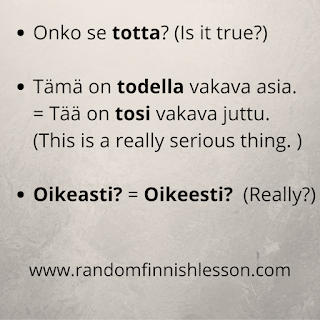
  • Onko se totta? - Is it true?
  • Totta kai! - Of course! (Yes, the direct translation is very illogically True, I suppose)

Here are some expressions with the word tosi that kind of lose their cool in translation:

  • Tosi kuin vesi! - True as water!
  • Nyt on tosi kyseessä. - It's a serious matter now. 

Tosi is also the spoken language version of todella, which means very. 


Also oikein and hyvin mean very, but they sound more formal and old-fashioned than todella or tosi.

  • Todella hyvä asia! = Tosi kiva juttu! - A very nice thing!

Here's how to use todella (or tosi) in front of adjectives and adverbs:

  • Tämä on todella tärkeä asia. - This is a very important matter.
  • Tämä kakku on todella hyvää. - This cake is really good.
  • Se oli todella mielenkiintoinen luento. - It was a very interesting lecture. 
  • Mun piti miettiä tätä todella kauan. - I had to think about this for a really long time. 
  • Anteeksi. Mä sanoin todella rumasti. - I'm sorry. I said very uglily. 
  • Mä olen todella pahoillani. - I'm very sorry. 


Todella can also be used the same way as oikeasti - for real. 


Sometimes (very annoying) people even say aikuisten oikeasti - for adults' real. In spoken language, oikeasti becomes oikeesti.

  • Voinko mä oikeasti luottaa sinuun? - Can I really trust you?
  • Voit todellakin. - Yes, you certainly can.  (Add kin to make it even stronger.)
  • Oikeesti, mä yritin vain auttaa. - For real, I just tried to help. 
  • Lupaatko aikuisten oikeesti? - Do you promise, for really real?


If you liked this, you might also like my post about ihan.


About the author of Random Finnish Lesson: 

My name is Hanna Männikkölahti. I am a professional Finnish teacher who gives private online lessons and simplifies books into easy Finnish. Please read more in www.linktr.ee/hannamannikkolahti and follow this blog, if you want to be the first one to know when I post something new.